JIMMY McSTAY
History tends to confuse Jimmy with his elder brother Willie. They were both defenders, frequently played in the same team, winning Scottish Cup medals together three times in the 1920s, but whereas it was generally agreed that Willie was the better player (he was capped for Scotland 13 times whereas Jimmy’s only International honours were for the Scottish League), Jimmy was possibly the better captain.
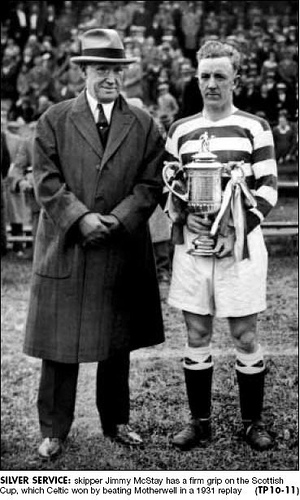
He took over from Willie as captain in 1929, and it was his fortune to lead the team in the tempestuous year of 1931 with the epic Scottish Cup Final win over Motherwell, the ground-breaking tour of North America and the tragic events of the death of John Thomson. McStay earned great respect and admiration from everyone for the dignified way in which he led the club during the traumatic aftermath of that event. Further tragedy would of course visit the club when Peter Scarff took ill and eventually died of tuberculosis.
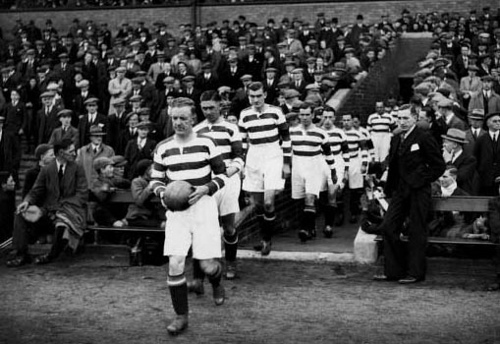
Jimmy McStay leads Celtic out in the first match after the tragic death of John Thomson – incidentally the man in the suit looks like Brendan Rodgers!
A trifle slow on the ground, he was imperious in the air and had tremendous passing ability. He was an attack minded centre-half in the tradition of Willie Loney whom he admired so much, and possibly Celtic lost rather too many goals because of his commitment to this role, but his greatest contribution to the club was in his inspirational leadership, so often being the voice of Maley on the field, and being able to bring out the best in key players like Peter Wilson, Alec Thomson and of course the goalscoring machine Jimmy McGrory.
He won five Scottish Cup medals in all, but only one Scottish League medal (in 1926 before he became captain). He was disappointed in this, but he never gave less than his best for his beloved Celtic. He went on to play for Hamilton Accies in 1934, and after managing Alloa immediately before the Second World War, became Maley’s successor in January 1940.
In this, he was was no great success, but the times were by no means easy in war-time and the Celtic Board seemed to lack any great commitment to gaining the success that would have meant so much to their support.
Continue to the next page to read about Paul and Willie McStay…