A new video from Liam Kelly on The Celtic Star’s You Tube channel this evening tells the story of the two fires at Celtic Park in 1904 and 1929 and outlines the damage down on each occasion and the overall cost to the club. Watch now with further details below….

Fire at Celtic Park on 9 May 1904 – Newspaper Report.
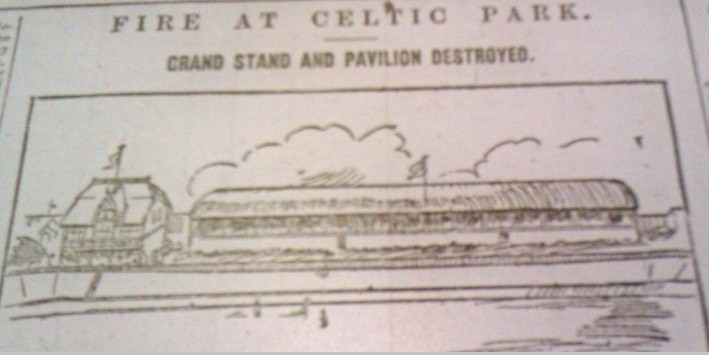

The Grand stand and Pavilion at the grounds of Celtic Park Parkhead were completely destroyed by fire last night, The first intimation of the outbreak was received by the fire brigade at 10.40 from a alarm on London Road, which had been broken by Mr James MacDonald. 69 Walkinshaw Street. Five minutes later another intimation was raised from a alarm in Great Eastern Road, sent by a man named Anderson, residing in Yate Street, Camlachie.
The Central and Eastern Divisions, under firemaster Paterson, were turned out, and on their arrival in the narrow roadway between the football ground and Janefield Cemetery the firemen found that the stand itself was a mass of flames, and the was no or little hope of saving the pavilion. The fire had originated near the east-end of the stand, and fanned by a slight easterly wind the flames were blown westward with terrible rapidity. In a incredible short time they worked their way through the open woodwork with a loud and ominous crackling which could be heard at a considerable distance.
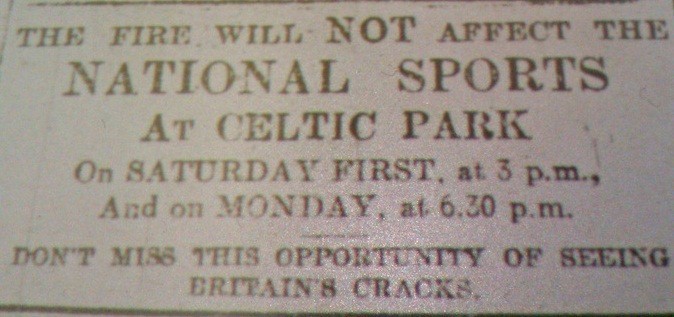

The wind carried the sparks in the directions of the “Grant” Stand and at one time there was serious danger of it becoming ignited. Fortunately the breeze was not of sufficient strength to carry the embers such a distance, but the scorched and blackened grass bore testimony to the danger which this operation was placed. At this juncture the fire presented a magnificent spectacle.
When at its height the fire shed a brilliant reflection on the sky, which was seen for miles around. As far as Coatbridge, the semi-circular glow showed clear above the horizon. From the other side of the park the spectacle was a fine one, the whole erection with the woodwork of the terracing and the roof all ablaze, the iron struts and girders standing out against the bright background, and parts of the corrugated iron roof falling in large sheets into the burning basement of the structure and throwing up great showers of sparks and flames.
About half an hour after the brigade arrived the large flagstaff which stood above at the centre of the stand fell outwards into the street, carrying with it a portion of the structure. The fire at this time had spread to the west end of the grand stand, and soon the pavilion also was in flames, This building being, like the stand, principally of wood and light inflammable material, burned rapidly and although some of the rooms in the ground flat were not destroyed by fire, the structure was completely wrecked.
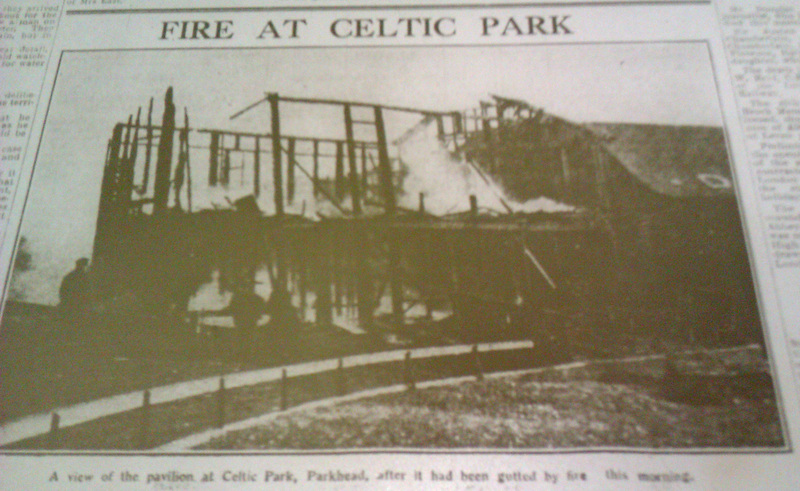

Fire at Celtic Park on 28 March 1929 – Newspaper Report
The blow is a particular severe one in the view of the fact that not only was the whole of the club’s equipment burned, but many photographic records of the club were destroyed, It will be a easy matter to replace the football gear, but the valuable old pictures cannot be replaced.
Flames Spread Rapidly – The outbreak was discovered shortly after nine o clock by some workmen engaged in the demolition of the Grant stand, which is on the opposite side of the field. They immediately raised the alarm, but so rapidly did the flames spread that practically a hour all that remained of the erection were some iron beams and support.
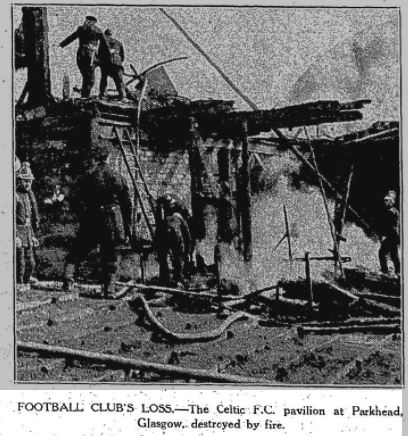
On seeing the flames burst through the windows of the pavilion the workmen rushed across the field and burst open the door with the intention to do all they could pending the arrival of the brigade. So dense was the smoke that poured through the pavilion, however, that they were unable to get to the seat of the fire.
The pavilion was composed almost entirely of wood, and the flames spread with such violence that by the time the brigade arrived the building resembled a well light torch. Little could be done to save the erection, and it was impossible to rescue any articles from the room in which they were lodged.
A Previous Fire – Celtic have been singularly unfortunate with their buildings, Some years ago, following a Celtic-Rangers game at Parkhead, a stand which was alongside the pavilion took fire and was burned to the ground. On that occasion the firemen were able to prevent the fire from spreading to the pavilion.
The Club’s Trophies – While the club’s gear and record’s were involved, it is understood the teams cups or shields were not involved in the conflagration. As has already been stated, work is proceeding at the present time with the demolition of the Grant stand. The latter building, which was also largely composed of wood, was found to be inadequate for existing conditions.
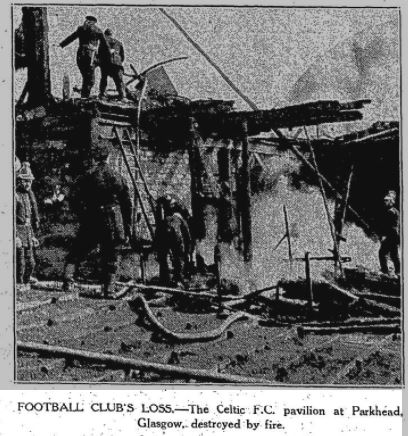
A Pathetic Spectacle – Viewed in the afternoon, Celtic Park presented a somewhat pathetic spectacle, and would prove especially so to any keen partisan of the club who wandered into see the devastation caused by the fire, On one side of the field was the partially dismantled grand stand, and right at the door on the Janefield side was the blackened ruins of what was once a old-fashioned but cosy pavilion. Charred wooden remains lay around, and on a half burned wall was still fastened the familiar notice which barred from the precincts all but players and officials, Were the front wall of the pavilion was wont to exist was a sodden mixture of burned wood, out of which standing at a dizzy angle the clubs safe and the remains of a easy chair.
The Club Records – Many hopes centred around that safe, The heat had cleared it all of pain, but, with the exception of a slightly dented piece on one side, were it had struck a radiator when falling down from a second storey to the ground. It appeared to be intact. And in that safe, a “Times” reporter was informed, were the valuable old records of the club, going back to the days when enthusiasts in the Parkhead district set out to obtain a field on which to play football and raise what money they could on behalf of the Sisters of Charity in Parkhead and other deserving institutions.
Photo of Original Team – The loss of these books would have amounted almost to a club calamity. There are still many people that remember the formation of the team in 1888, but with the loss of the records it would practically be a impossibility to have at any time compiled a authentic history of Celtic. At the same time many fine old photographs went up in the pall of smoke. These included a group of the original Celtic team, the first Celtic team to win the Scottish Cup. the first Celtic team to win the League Championship. and single photographs of Micky Dunbar, J.H.McLaughlin, John Glass, and other men who were prominent in the early days.
A picture in The Scotsman newspaper after the Pavilion at Celtic Park was destroyed in 1929. It was the stadium’s second fire and some really valuable photographs from our early years were lost pic.twitter.com/PgDjlRe2Ya
— Liam Kelly (@cfcliamk96) January 5, 2022