
SEVENTIES EURO SPECIALS- CELTIC v UJPEST DOZSA, 1972…
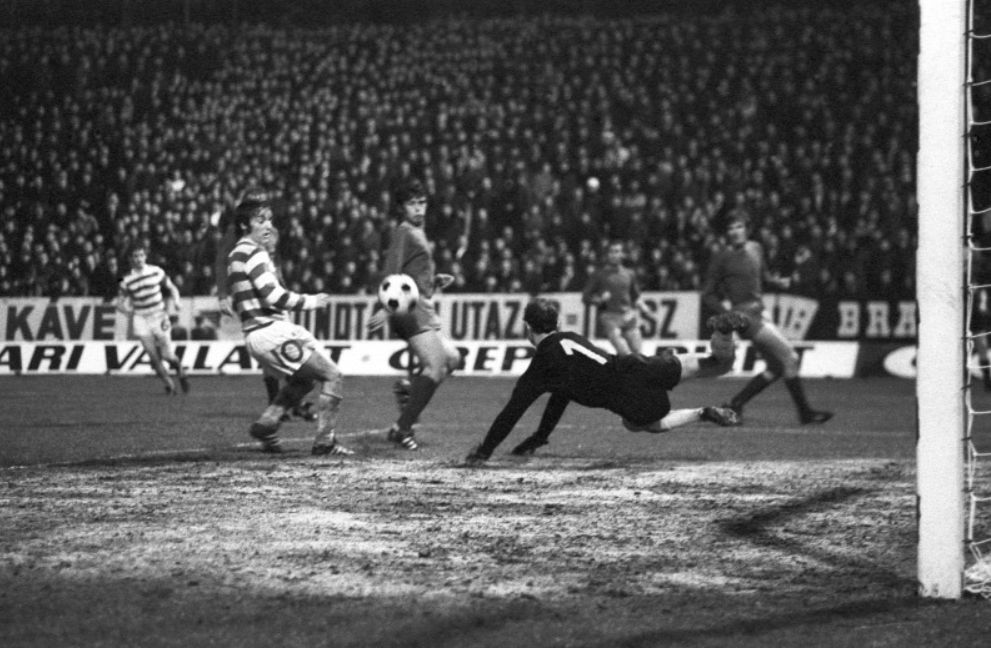
The magnificent result in Budapest was followed by one of those legendary events which seem to occur regularly throughout Celtic’s history. Richard Burton and Elizabeth Taylor, at the time arguably the most famous actors in the world, happened to be staying at the Intercontinental Hotel in the city whilst Burton was filming Bluebeard on the outskirts of Budapest.
Richard and Liz were joined there by around 130 Celtic fans who had flown over for the game on a charter flight. Accompanying them was journalist Gerry McNee, then of the Daily Express and later of Scotsport fame. McNee, with a good nose for a potential story, offered Burton and Taylor tickets for the match. Burton then invited McNee to meet him at the film studios, explaining that they would not be able to attend the game but would instead host an after-match party for all connected with Celtic – players, officials and fans.
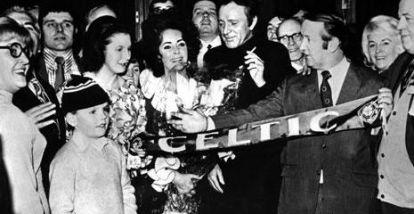
Celtic players and officials had to decline the invitation as they were leaving Budapest immediately after the match. However, the fans were delighted to accept and joined the famous couple in the hotel ballroom after the match. Burton declared: “The till rings up £5000 before the party ends”.
Glasses of whisky were served upon silver trays, followed by caviar and champagne. Ten-year-old Sean McKenna from Hamilton was asked to present a bouquet to Taylor, who responded by kissing him on each cheek! Richard Burton then led the singing of “I Belong to Glasgow”.
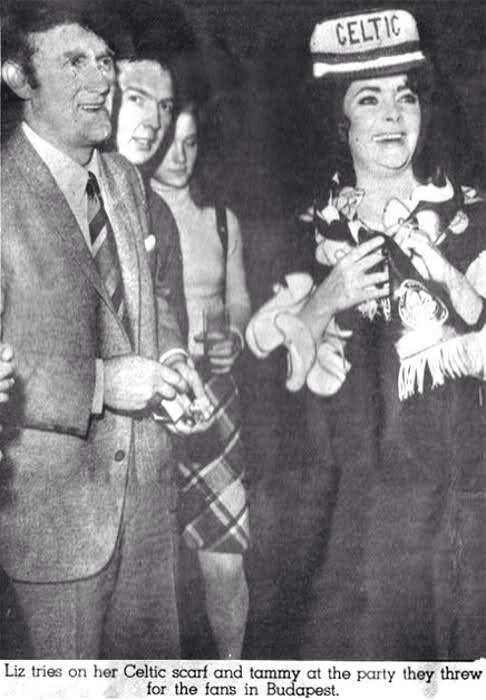
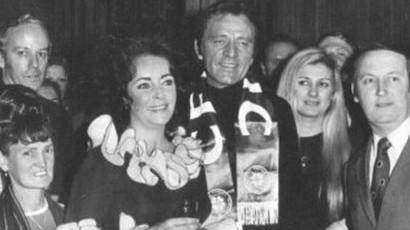
McNee continues in The Story of Celtic (1978): “The scenes were unbelievable. Imagine ordinary football punters from Glasgow mixing with the world’s highest-paid movie stars! Liz and Richard accepted Celtic hats and scarfs as souvenirs and spent over an hour chatting to the mesmerized group.”
For all who were there, it was a truly unforgettable evening. Sean McKenna relived his memories in the Sunday Mail of 27 March 2011, saying: “I have never really found any woman as nice as her since, well looks wise anyway.”
As for the return leg, Celtic were now hot favourites to go through. Raymond Jacobs of the Glasgow Herald went so far to say that “it must surely be only a formal proceeding before Celtic advance.” The writer in The Scotsman was much more circumspect, pointing out that Ujpest had played only THREE competitive games before the first leg and were sure to be fitter and sharper in Glasgow. “Celtic would be stupid to write off Ujpest yet.”
Added to the likelihood that the Hungarians would have greater match-fitness in Glasgow was the classic dilemma facing any side with a lead after an away match: hold on to the lead, or add to it? This was a particular issue for Celtic, whose European performances in Glasgow were always characterised by speed, close pressing and all-out attack. Against a side which had recently won in Leeds and Valencia, Celtic would have to exercise a degree of caution which would not come naturally.
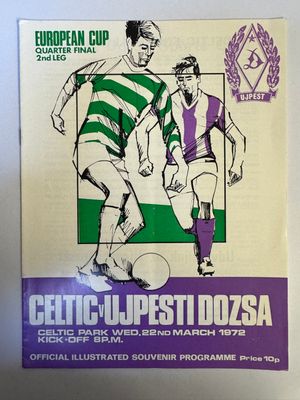
The second leg took place on 22 March 1972 in front of an all-ticket crowd of 75 000. In his book “Harry Hood- Twice as Good”, Matt Corr recalls the excitement he felt when he received a stand ticket for the match as his 11th birthday present: “Somehow I managed to get through the school day and took my seat to witness the magical spectacle of a packed Celtic Park under the floodlights. I will never, ever forget that moment.”
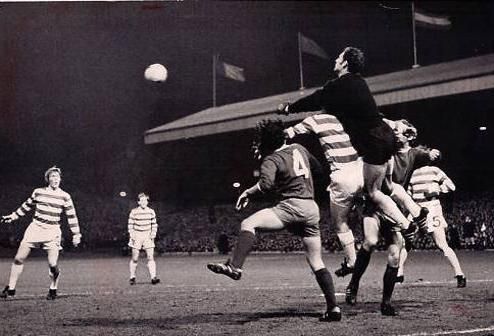
European matches at Celtic Park did indeed have a unique atmosphere in those days but the Hungarians were confident about retrieving the tie and certainly had the ability to win in Glasgow.
The scale of Celtic’s achievement in winning in Budapest was highlighted as Celtic fans could admire the quality of Ujpest at first hand. Looking sharper and fitter than they had in the first leg, Ujpest came at Celtic from the start and took the lead after only five minutes through Anton Dunai. The Hungarians continued to be a constant threat throughout the first half whereas Celtic, in direct contrast, struggled to find any fluency, appearing to be caught in the quandary of trying to level the match whilst also exercising defensive caution.
Thankfully, Celtic started the second half more strongly, with a Bobby Murdoch free kick and a fierce shot from Harry Hood bringing excellent saves from the Ujpest keeper. The turning point of match came after 60 minutes when Jimmy Johnstone came on for the injured Jim Brogan. Not only was Jinky the man the Hungarians feared most, but the change also meant Davie Hay moving to left back and Dalglish dropping to midfield. Almost immediately, Celtic’s overall play was better coordinated.
In attack, Lennox’s tireless running on the left and Johnstone’s willingness to take on the Ujpest defenders on the right were combined with a tireless performance from Lou Macari, who constantly chased and harried his opposite numbers. After 64 minutes, Celtic’s pressure was rewarded when Mauser tried to head a long pass from Connelly back to his own keeper. Macari cleverly anticipated the defender’s intentions, beating the keeper to the ball and delicately lobbing it over him.
Even with the score now 3-2 to Celtic on aggregate, “the Celtic players were nervously treading a tightrope that could have snapped with tension; one more goal from Ujpest would have meant extra-time.” (Graham McColl, Celtic in Europe) Indeed, the Hungarians continued to press until the very end, and it was a huge relief to all connected with Celtic when the match ended 1-1. Celtic were through to another European Cup semi-final, their THIRD in SIX seasons, where they would face old foes Inter Milan.
In hindsight, the elimination of Ujpest Dozsa in 1972 appears an even greater accomplishment than was recognised at the time. Firstly, Ujpest were an excellent side, who were in the process of winning their domestic championship for seven successive seasons. In season 1972/73, they would eliminate Celtic by 4-2 on aggregate in the second round and lose in the next round to eventual finalists Juventus only on away goals. They would go one stage further in 1973/74, losing 1-4 on aggregate to eventual winners Bayern Munich in the semi-final.
Secondly, as Stein recognised, this was a young Celtic side with five members of the Quality Street Gang playing in Budapest. Davie Hay was the eldest at 24, whilst George Connelly was 23. Lou Macari was still only 22, with Danny McGrain and Kenny Dalglish the youngest, each aged only 21.
These players “were of a suitable calibre to convince all who saw them that Celtic’s place as leading lights in Europe was assured for some time to come.” (Graham McColl, Celtic in Europe) Tragically for Celtic, a little more than two years later, both Macari and Hay had been sold for huge sums, whilst George Connelly’s career had started its downward spiral. One can only speculate what Celtic might have achieved in the remainder of the 70s had they kept this remarkable group together.
Finally, Celtic’s away win in Budapest would in time be looked upon as an even greater achievement because of Celtic’s relative – and unforeseen – decline in the years that followed. Celtic would not win another match in Europe against top quality opposition for more than a DECADE, when they finally won a memorable victory over Ajax in the first round of the European Cup in September 1982.
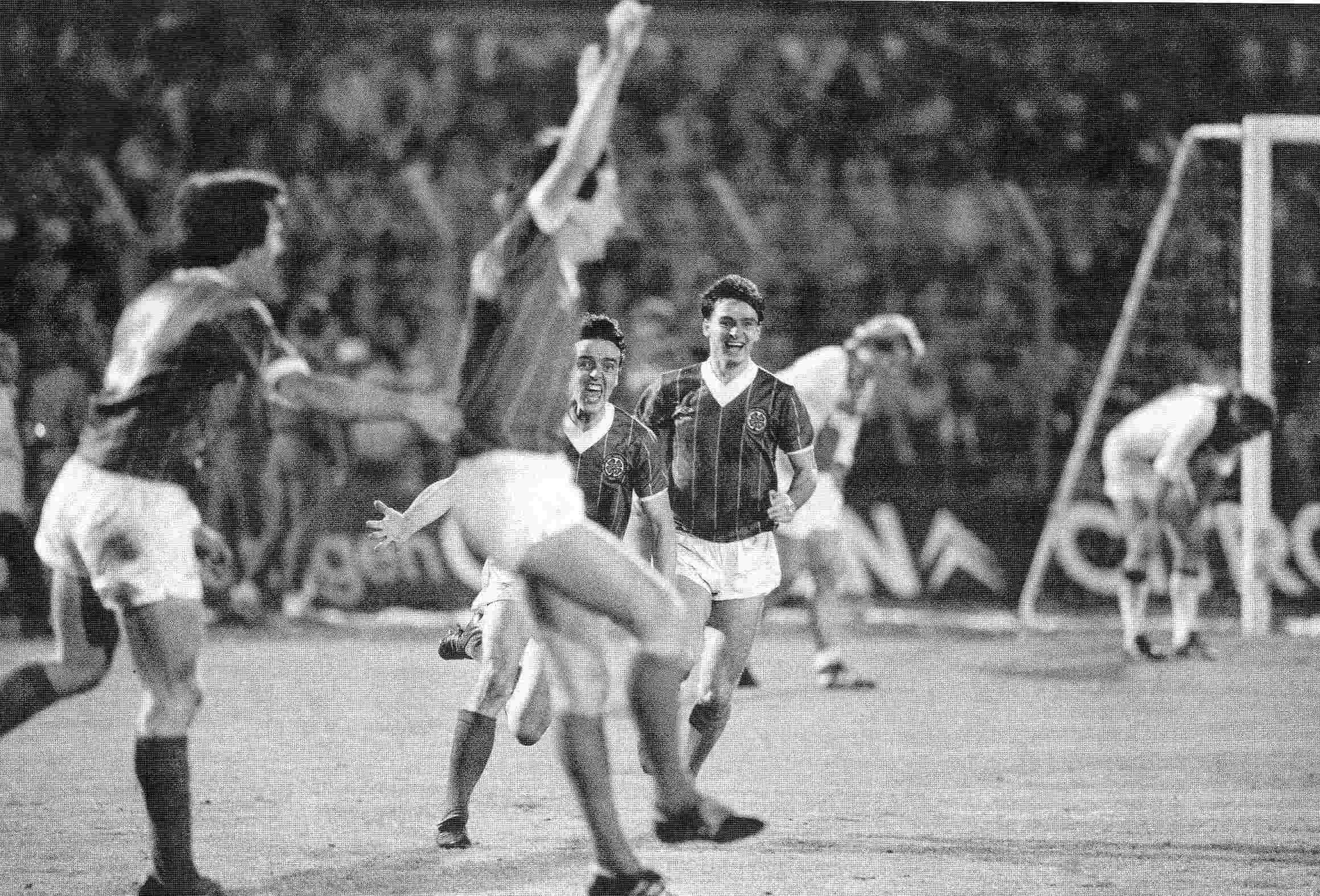
Ajax v Celtic, European Cup first round, 2nd leg. 29 September 1982. Photo The Celtic Wiki
For a generation of Celtic fans, the famous win in Budapest was the last glorious away result they could recall until George McCluskey scored that marvellous last-minute goal in Amsterdam.
In April 1972, however, all that mattered was that Celtic were heading inexorably to a league and cup Double and had another European Cup semi-final on the horizon…
James McDevitt
READ Part 1 – Seventies Euro Specials – Ujpest Dozsa v Celtic, 1972


Celtic in the Thirties by Matt Corr. Click on image to order


