The Celts tomorrow face Hibs for the first time this season. The earliest time the two sides met in any competitive game was more than 130 years ago. It proved to be a very controversial tie, one that took weeks to settle…
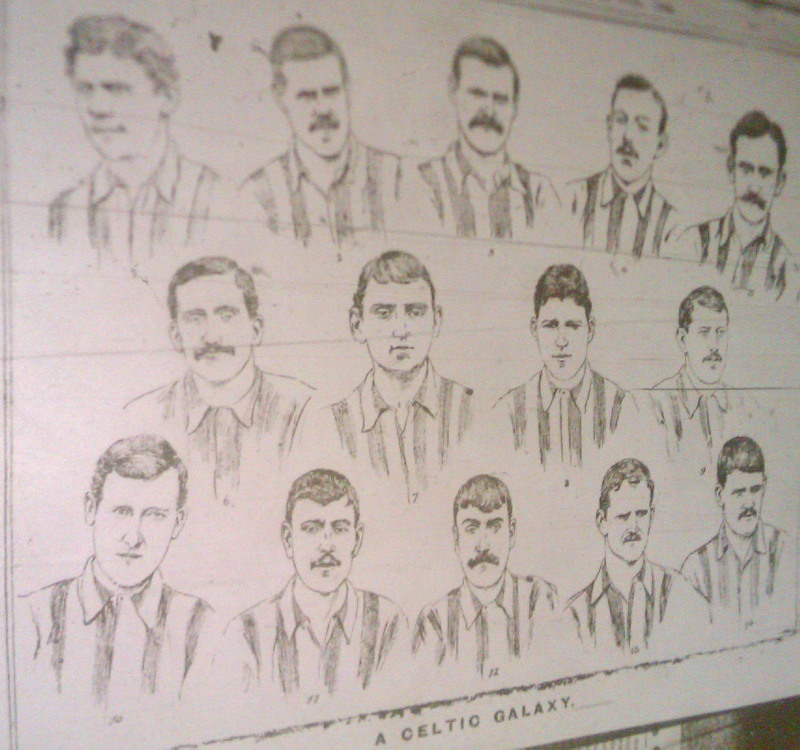
The Celtic team Lin-up, 1894/95 season, image via The Celtic Wiki
This is the story of that fixture, a tale which highlights different footballing experiences in Celtic’s opening years.
Celtic had won the League in 1893 and 1894, becoming the first team to retain the title as sole champions. The Bhoys wanted to build on this in 1894-95, including winning the Scottish Cup, which was then seen as the country’s top prize.
In Celtic’s first Scottish Cup tie that season, they met Queen’s Park. The Spiders were then the top team in the competition, but Celtic easily disposed of them with a 4-1 scoreline. At the same time, Hibs demolished Forfar Athletic, winning 6-1 in Edinburgh. This set up a meeting between the two green teams in the following round.
Newspapers claimed that Hibs had been praying for such a draw. A great many people associated with Hibs disliked Celtic, and wanted the chance to beat them on the pitch. Reflecting the two club’s Irish heritage and political debate of the time, one journalist stated that the game would have “daggers drawn”, because “the teams have as much regard for each other as the Redmondites have for the ‘Antis’.”
In a resentment that can still be witnessed to this day, Hibs blamed Celtic for their “extinction.” They had been Scotland’s dominant Irish club prior to Celtic’s formation, and helped the Glasgow club’s rise. Then they suffered an enormous collapse. Hibs especially resented many of their best players switching to Celtic Park.
Whilst there is some truth in this, it is also partially selective. In those days, there was no professionalism and so players were not tied to clubs in a way which would later be the case. Also, it ignores the reality that Hibs often took players from other sides, such as Ayrshire’s Cronberry Eglinton.
The Scottish Cup tie involved a trip to the east coast for Celtic. Playing at Easter Road on 15 December 1894, it was expected to be a tough game. There was pre-match excitement; one reporter predicted it would be one of the “greatest ever ties” seen in “Scotia’s capital.”
A huge crowd was present, attracted by the pairing of Scotland’s two main Irish clubs, and Celtic’s first visit to Easter Road. Hibs hoped to capitalise on this interest. Pre-match adverts said there would be no half-time admission, forcing fans to attend the full game and pay full price.
This did nothing to dampen enthusiasm, indeed it was quite the opposite. One report described a “torrent” of fans pushing into the ground. There were even fears that too big a crowd would gain entry, and perhaps spill onto the pitch. This did not eventually happen, although some sections of Easter Road were said to be dangerously overcrowded.
The condition of the pitch also attracted comment. One match preview suggested that Celtic would struggle on this because the state of the turf made it “no place for sand dancers,” implying it would blunt the technical skills of the Celtic team.
Although it was in Edinburgh and three-quarters of fans backed the home men, a local journalist said the Celts got the loudest cheered when they arrived, ahead of the 2.15pm kick off. In a reminder of the extra edge attached to this game, when Celtic won the coin toss, this was greeted with jeers and complaints by the home fans.
Reflecting this challenge, the Celts had a strong team: McArthur, Dunbar, Doyle, Maley, Kelly, McEleny, Madden, Blessington, Cassidy, Campbell, Divers. Despite this, it was the home men that started best, but Celtic eventually settled.
The goalkeepers at each end were kept busy, to the delight of those spectators present. A good interception from one Hibs man – whilst Celtic’s Blessington was said to be “diddling” on the ball – also cheered the home section. However, when half-time arrived, there were not yet any goals.
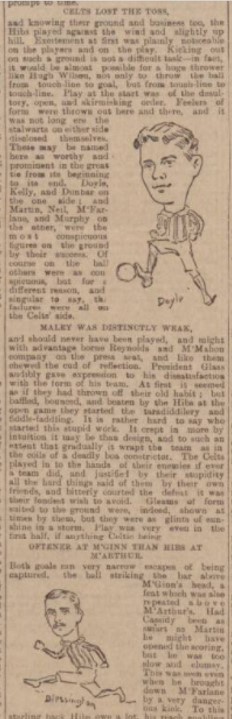
In the second half, this would very quickly change. Within a minute of restarting, it was the Edinburgh men who had cause for celebration. The ball fell to Michael Murray – who has the strange distinction of playing for and against Celtic in their first league-winning season – and he “smartly tipped the leather past Dunbar” in the Celtic goal.
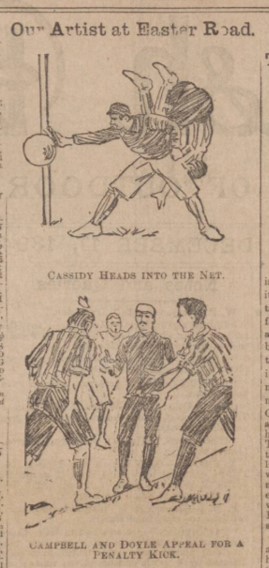
The Bhoys sought an equaliser, but without luck. As a sign of their troubles, even a penalty could not help. Following a foul, Johnny Madden took the kick but McGinn in the Hibs goal tipped it over the bar.
In the last minute, the hopes of the Glasgow East End men were truly extinguished. Dan Doyle was penalised for handball, and a Murphy free-kick was deflected into the net by Cassidy. The home team led 2-0, which was the final score.
The Edinburgh Irish had claimed a big win and there were huge celebrations. In a nod to the tensions which existed between the teams, the Scottish Referee publication had a headline which read “Revenge is sweet.”
The Hibs team were showered with compliments afterwards, and tipped to repeat their 1887 experience by winning the Scottish Cup. In particular, reporters praised the performance of young Robert Neil, suggesting his efforts had made a huge difference, a fact which later became of huge significance.