
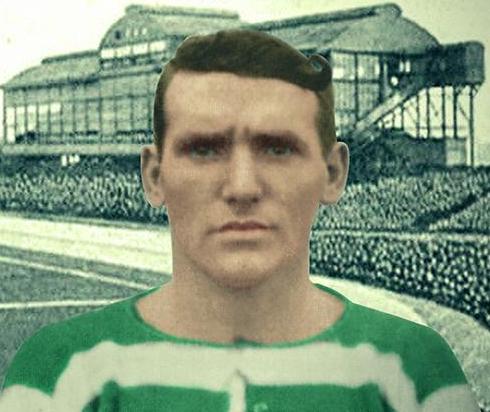
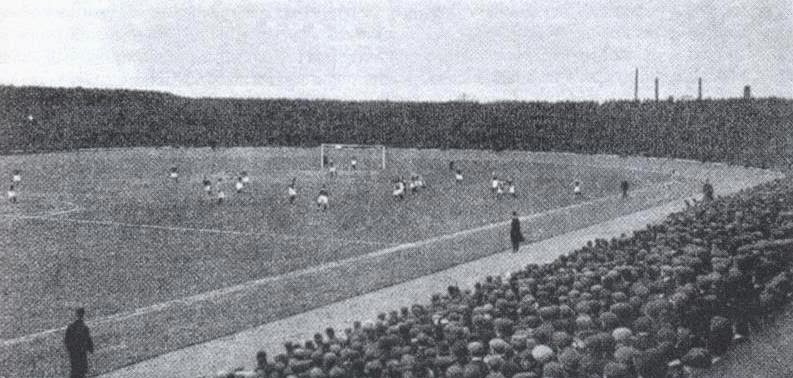
Thus half-time saw Celtic in better spirits than Rangers, for they were the team who had come back and were now on level terms. It would be a prolonged half time interval for a collection was being taken for the families of the victims of a crowd disaster at a Scottish cricket match! This was the Perthshire v. Forfarshire game at the North Inch, Perth last summer when a temporary stand had collapsed injuring many people, some of whom were permanently maimed and therefore unable, in those pre-Welfare State days, to support their family. The huge crowd contributed generously, throwing coins into sheets which volunteers walked round the running track with.
In the Celtic dressing room, Maley came in, said they were doing well and wished them all the best in the second half. He then, as was his wont, went off to have a cup of tea with the Rangers manager, his good friend William Wilton, leaving the players to talk among themselves. The very experienced Willie Orr was of course the captain and he said his piece but it was then that Sunny Jim went around everyone cheering them up.
Davie Adams tried to apologise for his howlers, but was told by Sunny to “shut up aboot it, Davie. Show us what ye can do in the second half!”, Jimmy McMenemy was told to keep up the good stuff, Davie Hamilton, a shy retiring kind of man on the left wing was given a word of encouragement, and then the other shy man in the team, Jimmy Quinn, was pointed to by Young who proclaimed prophetically, “This is the man who will do it for us”. Then another early example of his famous war cry “Face the ball, Celts!”
The second half opened with Rangers on top, but that was only a temporary phenomenon as the Celtic midfield once again rallied and took control. Playing towards the as yet incomplete East Terracing (which in years to come would house huge Celtic crowds), Celtic charged forward, with everything done in their triangles of Young, Muir and McMenemy on the right side of midfield, Hay, Hamilton and Somers on the left “passing prettily”, and a vice like grip in the centre of the midfield with Young, Loney and Hay in total command. Yet the Rangers defence held out, and a replay looked the most likely outcome, until Jimmy Quinn, already a hero, became immortal and ensured that his name will be mentioned whenever anyone talks about Celtic and football.
The winning goal had some similarities to his first goal, but this time it came from a visionary pass from captain James “Dun” Hay. Quinn was on his way to goal when he was tackled fiercely by the fair haired Nick Smith. It was brutal and might have floored lesser men, but this was Jimmy Quinn! He stumbled, but picked himself up, gathered the ball and slid the ball past the advancing goalkeeper. As Hampden erupted in applause, Jimmy merely turned round and walked back to the centre circle looking as “cool as Hell” in the unlikely simile of The Glasgow Observer, as his team mates went berserk all around him.
Another newspaper talked more graphically about “The Croy express being almost dismembered by his team-mates”. But Jimmy was not too given to such shows of emotion. “The game’s no finished yet”, he muttered with grim determination as he marched back purposefully, head down and eyes set, to the centre line and Sunny Jim was seen with clenched fists, telling the players the same message.
Indeed there were ten minutes to go, but Rangers were a well beaten team. As full time approached, so too did the volume of applause and cheering rise around Hampden with green and white favours now prominent. Full time came when Mr Robertson blew and pointed to the pavilion. Sunny Jim jumped up and clapped both hands above his head, then shook hands with his Rangers opponents before joining in the general mayhem of this young and enthusiastic Celtic side. Celtic had won their fourth Scottish Cup, now level with Rangers and one ahead of Hearts, although still some way behind the ten of Queen’s Park. There was dancing in the streets of the Gorbals that night.
The Dundee Courier, which, in its desire to appease the Dundee Irish of Lochee and Hawkhill, tended to support Celtic unless they were playing against Dundee, naturally is in ecstacy about the performance of Jimmy Quinn, but also has this to say about Sunny Jim …”Young, who though sometimes inclined to methods not permitted by the laws of the game, was about the best half on the field”. Then as an afterthought “Lonie (sic) and Hay were also good”. The “methods not permitted by the laws of the game” would appear to be a reference to Sunny’s inclination to dish out a little raw meat, now and again, and to deliver a few robust challenges, when the occasion demanded.
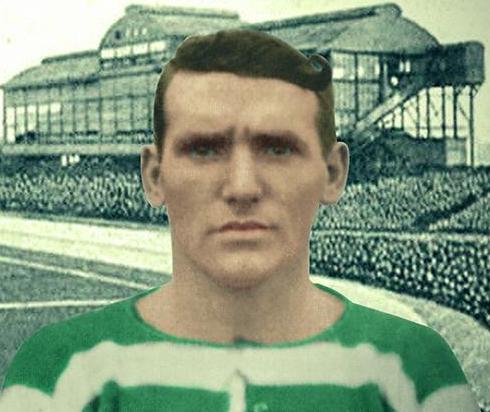
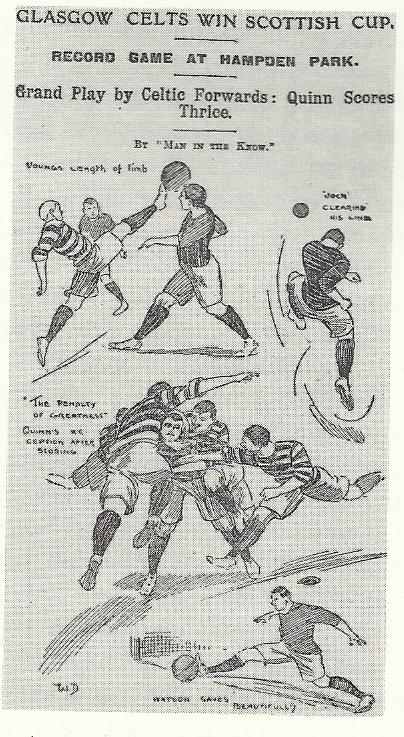
The Glasgow Observer reluctantly agreed about Sunny’s over-motivation. Although enthusiastic about his “length of limb”, it says that “Young wasn’t uniformly safe in his tackling and at times he failed to control his temper.” This was however only a small point in its glowing praise of Celtic’s performance. It cannot have helped the cause of Celtic’s increasing desire to be integrated into Scottish society when it talks about an “Irish Football Triumph” – a somewhat ludicrous headline when one considers that all eleven of the Celtic team were born in Scotland, and that a handful of them were from a Protestant background.
The real significance of this game, much talked about even in England in the context of “hat-trick Quinn”, however, lay in what happened next. The Cup final immortalised by Jimmy Quinn was the springboard for the team that would go on to dominate Edwardian Scotland and become, without any great doubt, the greatest team on earth, winning six League titles in a row. There is indeed a very strong parallel with what happened 61 years later in 1965.
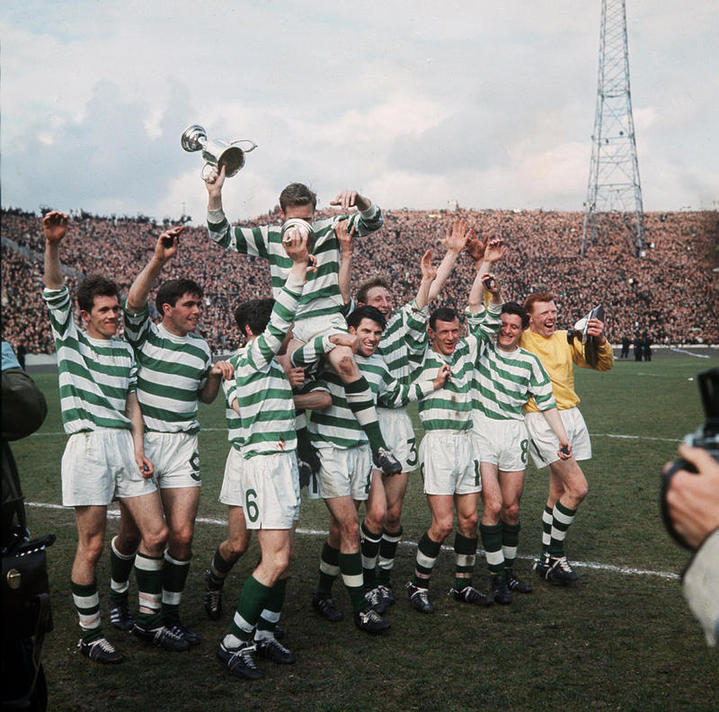
The epic Scottish Cup win against Dunfermline Athletic (two goals from Bertie Auld and Billy McNeill’s late headed winner) opened the doors for the glory that was to come. That team of the late 1960s would also be the greatest team on earth, but, as everyone admitted, it might not have happened but for that Scottish Cup final of 1965. For 1965, read 1904 and one will get an idea of how significant it was.
To be continued
David Potter
*An extract from David Potter’s biography of Celtic legend Sunny Jim Young.




“Face the ball, Celts!” – Would love to see a banner made up with this Sunny Jim battle cry today or some other historic styled banners.
As usual David fantastic reading. I would like to add a 3rd important cup final win and that would be v airdrie (95) when big pierre scored as the years of winning nothing since Joe Miller cup final (89) were awful