

No KYC sports betting sites let you sign up and wager using only an email address or crypto wallet, with no upfront identity documents required. For US bettors who want faster onboarding, broader geographic reach, and crypto-native withdrawals, these platforms offer a genuine alternative to state-regulated books, though the privacy advantage comes with trade-offs in odds margins and consumer protections.
This page ranks 10 no verification betting sites evaluated on their KYC model, odds margin percentage, crypto withdrawal speed, and rollover requirements. You’ll also find a clear explanation of when verification can still be triggered, which cryptocurrencies give the fastest and cheapest payouts, and what the privacy trade-off actually costs in measurable terms.
Top No KYC Sports Betting Sites for 2026






































- LuckyRollers: a crypto-native sportsbook and casino that lets you sign up with email only, no upfront ID required, with instant payouts across 13 coins and a welcome package worth up to $30,000 plus 100 free spins and five free sports bets.
- Betpanda: a crypto-exclusive sportsbook and casino with email-only signup and discretionary KYC reserved in its terms rather than demanded at the door, backed by zero-fee instant deposits and withdrawals and a 100% bonus up to 1 BTC.
- CoinCasino: an Anjouan-licensed crypto sportsbook and casino offering flexible account creation via email, Telegram, or wallet connection, with a 200% welcome offer worth up to $30,000.
Detailed No KYC Sportsbook Reviews
Best for No-KYC Signup: LuckyRollers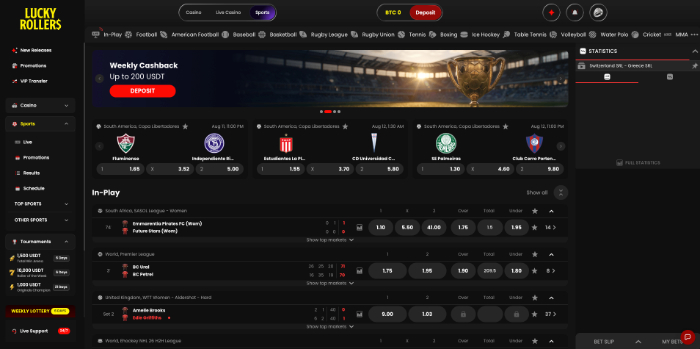
LuckyRollers lets you open a sports betting account and start wagering with nothing more than an email, no identity documents required at signup, and it pays out instantly across 13 cryptocurrencies, including Bitcoin and USDT. The sportsbook sits inside the same wallet as the casino, so privacy-focused US bettors can move between verticals without ever touching a KYC form.
- Anonymous sign-up with no mandatory ID uploads for sports betting
- Crypto cashier spanning 13 coins, including Bitcoin and USDT
- Combined casino and sportsbook under one wallet
- Crypto-only account setup for sports betting
- No native mobile app, browser-based access only
- Fully crypto-only cashier with no fiat deposit options
| License | Curacao |
|---|---|
| Established | 2025 |
| Min Deposit | $10 |
| Payout Time | 0-24h |
| Payment Methods | 13 cryptocurrencies incl. Bitcoin, USDT |
| Sports Betting | Yes |
Best for Crypto-Exclusive Payments: Betpanda
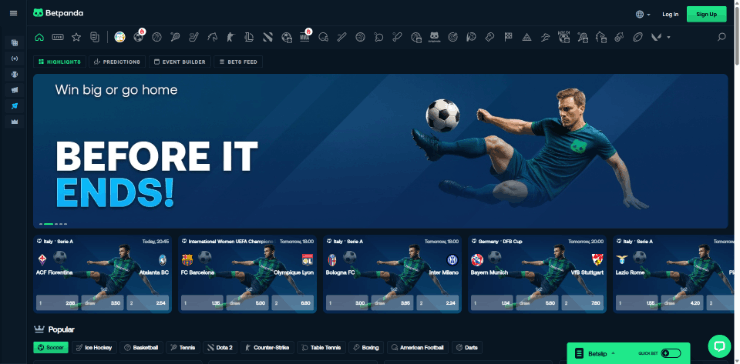
Betpanda strips signup down to an email and password, no ID upload sits in the default sports betting registration flow, and every deposit or withdrawal moves on-chain across 13 coins, including Bitcoin and USDT. Its terms do reserve the right to request identity verification at any time if an account is flagged for risk, so treat the no-KYC experience as the default rather than an absolute guarantee. Licensed out of Costa Rica, it pairs that light onboarding with a full sportsbook covering major leagues and live in-play markets.
- Email-only signup with no ID upload for sports betting accounts
- Crypto cashier spanning 13 coins, including Bitcoin and USDT
- Zero-fee, instant crypto deposits across 13 coins, including Bitcoin and USDT
- Live in-play markets plus an Event Builder for custom multis
- No native mobile app, browser-only access
- Sports betting funding limited to crypto, no fiat deposit rails
| License | Costa Rica |
|---|---|
| Established | 2023 |
| Min Deposit | $1 |
| Payout Time | 0-24h |
| Payment Methods | 13 cryptocurrencies incl. Bitcoin, USDT |
| Sports Betting | Yes |
Best for Flexible Account Creation: CoinCasino
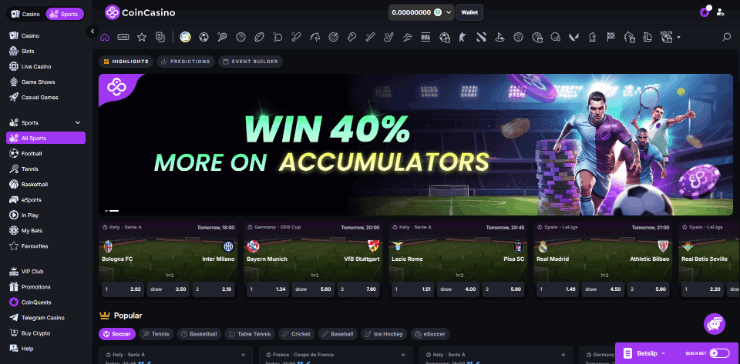
CoinCasino opens a sports betting account through email, a Telegram handle, or a direct wallet connection, skipping identity documents at signup entirely, and settles across 18 cryptocurrencies, including Bitcoin and USDT. Independent reviews note that verification can still surface at withdrawal or on a compliance flag, so the document-free promise is strongest at the front end rather than guaranteed all the way through. Operating under an Anjouan license since 2017, it backs that flexible onboarding with a sportsbook spanning global leagues, esports, and live in-play markets.
- Registration via email, Telegram, or wallet connection with no ID at signup
- Wide crypto stack across 18 coins, including Bitcoin and USDT
- Sportsbook covers global leagues, esports, and live in-play betting
- Casino library spans slots, live tables, and jackpots across 81 providers
- No native mobile app, mobile-optimized browser only
- 60x wagering requirement on the welcome bonus is higher than typical
| License | Anjouan |
|---|---|
| Established | 2017 |
| Min Deposit | $10 |
| Payout Time | 0-24h |
| Payment Methods | 18 cryptocurrencies incl. Bitcoin, USDT |
| Sports Betting | Yes |
No KYC Sports Betting Comparison Table
The table below puts all 10 operators side by side by KYC model, welcome offer, and quoted payout time. Use it to shortlist before reading the full reviews, then check each full review for licensing, rollover, and market context.
| Rank | Sportsbook | KYC Model | Welcome Offer | Payout Time | Licence |
|---|---|---|---|---|---|
| 1 | LuckyRollers | No ID required, play anonymously | 100% up to 30,000 USDT + 100 Free Spins + 1 Free Bet | 0-24h | Curacao |
| 2 | Betpanda | Email-only sign-up, discretionary KYC in terms | 100% Bonus up to 1 BTC | 0-24h | Costa Rica |
| 3 | CoinCasino | Email, Telegram, or wallet sign-up; KYC possible at withdrawal | 200% up to $30,000 | 0-24h | Anjouan |
| 4 | Cryptorino | Not required to play, sometimes requested for safety reasons | 100% and 10% Weekly Cashback | 24h | Costa Rica |
| 5 | Hyper Lucky | Email sign-up, proof of ID might be asked before first deposit | 20% Daily Cashback up to $10,000 + 100 Free Spins | 1-24h | Costa Rica |
| 6 | CasinoPunkz |
Email sign-up, verification not required in most cases |
100% up to 20.000€ | Instant-1 hour | Anjouan |
| 7 | Thrill | Email or Google account sign-up, may request your address and ID number on sign-up | Up to 70% Rakeback + 10% Cashback | 24h | Anjouan |
| 8 | BC Game | Email sign-up, may request ID for deposits | 470% up to $4,000 + 400 Free Spins | 24h | Anjouan |
| 9 | Wild.io | Email, Telegram or Google sign-up, ID may be requested for withdrawals | 400% up to $10,000 + 300 FS | 24h | Anjouan |
| 10 | Vave | Email, Telegram or Google sign-up, ID may be requested for withdrawals | 150% Casino Bonus up to 1.5 BTC + 100 Free Spins | 0-24h | Costa Rica |
KYC model consistency is the most important column here. Every operator in this list carries one of three standardized labels: No Upfront KYC, Risk-Based KYC, or Delayed KYC. Check that label before you deposit, then read the trigger conditions section below to understand when documents can still be requested.
Betting Sites No ID Verification: What ‘No KYC’ Actually Means
The phrase “no KYC” is used loosely across betting sites without verification, and that looseness causes real problems for bettors who assume it means no checks at any stage. It does not. Understanding the three distinct models is the single most important thing you can do before choosing a platform.
No Upfront KYC means you create an account with an email address and password, or a wallet connection, and no identity documents are requested at registration. Documents may still be required if a specific trigger fires later. Risk-Based KYC means the platform runs automated signals on your account activity and requests documents only when those signals breach a threshold. Delayed KYC means documents are required before your first withdrawal regardless of the amount, the “no KYC” label refers only to the registration step, not the withdrawal step.
The distinction between a “no ID betting site” and a “no KYC sportsbook” matters here. The phrase “betting sites no ID verification” usually refers to sites that require no documents at registration, not sites that guarantee no checks at every stage. A true no KYC sportsbook requires no documents at any stage, a much rarer and harder standard to meet. Most platforms in this space fall into the first category, not the second. Betting sites without ID verification at sign-up can and do request documents later.
Even on platforms that never request documents, you are not fully anonymous. Crypto-native sportsbooks log wallet addresses, device fingerprints, IP addresses, and withdrawal patterns. Sports betting apps that don’t require ID at sign-up are not gambling sites without verification at every stage, which is why anonymous betting sites still need close scrutiny. “No KYC” reduces upfront data collection; it does not eliminate the data trail. The same distinction applies when comparing an online casino without KYC, an online casino no ID option, or an online casino without ID verification. For a deeper look at the casino equivalent of this model, see our guide of no KYC casinos.
KYC Trigger Conditions: What Can Happen
The following triggers are documented in operator terms across this space. Understanding them tells you exactly when a document request can arrive even at a platform marketed as no-verification.
| Trigger | What Can Happen |
|---|---|
| Withdrawal above threshold | The platform pauses the withdrawal and requests government-issued ID, proof of address, or both before releasing funds |
| AML flag on transaction pattern | Unusual deposit frequency, round-number deposits, or rapid turnover can trigger an automated AML review requiring source-of-funds documentation |
| Bonus abuse detection | Multiple accounts, coordinated bonus claims, or matched-betting patterns can prompt a full identity check and account suspension pending review |
| Restricted-jurisdiction IP match | An IP address resolving to a geo-restricted country can trigger account verification or outright suspension; VPN use may itself violate operator terms |
| Account security review | Unusual login location, failed 2FA attempts, or a flagged device fingerprint can prompt a security-driven identity check before account access is restored |
Tax and Reporting Questions for Large Wins
A no-KYC registration flow does not remove tax or source-of-funds questions. Large wins or withdrawals can still trigger a review, and US tax obligations on gambling winnings exist independently of an operator’s verification policy. Keep records of deposits, withdrawals, and betting activity, particularly if you wager at high volume.
Curaçao eGaming and the Anjouan Gaming Board are the two licensing bodies present across this operator set. Both impose Anti-Money Laundering (AML) compliance obligations on their licensees, which is why withdrawal-threshold checks and AML flags exist even on platforms that advertise no upfront identity verification. Neither regulator enforces the same consumer protection standards as the UK Gambling Commission, but both require licensees to maintain AML procedures.
Anonymous Sports Betting: Payments and Withdrawals
Crypto is not a single payment method. The network you choose determines your fee, your settlement time, and your exposure to price volatility between deposit and withdrawal. Getting this right is the practical core of anonymous crypto sports betting, and it is what separates usable anonymous betting sites from platforms that make cashing out harder than it needs to be.
Which Crypto Works Best for No-Verification Withdrawals
USDT-TRC20 is the standout option for most bettors: near-zero network fees, settlement in under two minutes, and a stable dollar value that eliminates the price-volatility problem between deposit and cash-out. USDT on the ERC-20 network carries the same price stability but significantly higher gas fees during congestion, making TRC-20 the preferred network for regular withdrawals.
Litecoin (LTC) and XRP offer similarly low fees and predictable confirmation times, making both strong alternatives to USDT-TRC20 for crypto sports betting no KYC use cases. Bitcoin remains widely accepted but carries higher fees and slower confirmation times during peak network load, it is better suited to larger, less frequent withdrawals than to same-session cashouts.
The stablecoin bankroll advantage is worth stating clearly: holding your balance in USDT or USDC means the value you deposit is the value you withdraw, regardless of what Bitcoin or Ethereum does in the intervening period. For active sports bettors managing a rolling bankroll, that predictability matters more than any potential upside from holding a volatile coin. For more detail on fast crypto cashout mechanics, see our instant crypto withdrawals guide.
Ethereum is accepted at most platforms in this list but shares the ERC-20 fee problem during high-traffic periods. The core recommendation for anonymous crypto betting is: USDT-TRC20 for stability and speed, LTC or XRP as low-fee alternatives, Bitcoin for large infrequent withdrawals.
Fiat On-Ramps and the Hidden KYC Problem
Third-party fiat-to-crypto on-ramps such as Transak and MoonPay introduce their own identity verification requirements independent of the sportsbook. If you buy crypto through one of these services to fund a no-KYC sportsbook account, you have already completed a KYC process at the on-ramp level, your wallet address is linked to your verified identity in that provider’s database.
The cleanest approach for crypto sportsbook no KYC use is to fund deposits from a personal non-custodial wallet rather than sending directly from a centralized exchange. Centralized exchanges (Coinbase, Kraken, Binance) all require full KYC, any withdrawal from those platforms to a sportsbook creates a documented link between your verified exchange identity and your betting wallet address.
Skrill and Neteller are fiat eWallet options available at some operators in this list, but both carry their own identity verification requirements. Using either method at a no-KYC sportsbook does not exempt you from the eWallet provider’s own document checks. For a full breakdown of crypto deposit mechanics, our crypto casinos guide covers the wallet-to-platform flow in detail.
Centralized vs Web3 Sportsbooks: A Practical Distinction
Most platforms in this list are centralized crypto sportsbooks: they accept crypto deposits, maintain server-side account records, and defer KYC rather than eliminating it. BC Game operates a hybrid model that includes on-chain elements alongside its centralised account system, it is not a pure Web3 platform, but its architecture gives it more crypto-native flexibility than a traditional betting site.
A true Web3 or on-chain sportsbook uses wallet-only login with no account database, your wallet address is your identity, and settlement happens on-chain. This model eliminates the account-level data trail almost entirely, but it also eliminates consumer recourse if something goes wrong. Most bettors are better served by the centralized crypto sportsbook model, which balances privacy with practical dispute resolution.
How We Rank and Test No KYC Sportsbooks
The best no KYC betting sites earn their place in this list by performing across seven specific criteria, not by paying for placement. Here is exactly what each criterion measures.
- KYC Friction Score: What information is required at sign-up, whether documents are requested before the first withdrawal, and whether KYC trigger conditions are published in the operator’s terms rather than buried in small print.
- Odds Margin Measurement: We assess main-market lines on football match-winner and NBA spread against a mainstream regulated benchmark. No-KYC crypto sportsbooks typically run 4–7% margins, and reviews flag operators that exceed that range.
- Crypto Withdrawal Speed: We assess each quoted settlement window by network, covering Bitcoin, USDT-TRC20, LTC, and XRP, including the operator’s internal approval stage and on-chain confirmation time.
- Rollover Requirement Transparency: Specific multiplier for crypto deposits, fiat deposits, and bonus-linked deposits. We also check whether weekly or monthly payout caps apply and whether those caps are disclosed upfront.
- Licensing Verification: Named regulatory body confirmed against the regulator’s public operator register, not based on a self-reported badge in the site footer. Curaçao eGaming and Anjouan Gaming Board are the two bodies present in this operator set.
- Responsible Gambling Tools: Availability of deposit limits, session limits, and account-level self-exclusion without requiring full KYC to activate them. This is a gap no competitor currently addresses directly.
- Geo-Restriction Accuracy: US player accessibility verified by testing the registration flow from a US IP address. Where an operator geo-restricts US players, that is flagged explicitly in the operator profile.
- Mobile Experience: We assess responsive browser access, whether a web app or native app is available, and how clearly the deposit flow, bet slip, and confirmation screens work on a phone.
No KYC sports betting sites for US players occupy a specific position: they are not US-licensed services. Our methodology assesses their licensing standards on their own terms rather than against a domestic US benchmark that does not apply.
Bonuses at No KYC Betting Sites, What the Terms Actually Mean
Welcome bonuses at betting sites without KYC follow the same structural logic as mainstream sportsbook offers, but the rollover mechanics and KYC trigger risks add a layer of complexity worth understanding before you claim anything. The table below maps each bonus type to its realistic rollover range, minimum odds condition, and KYC risk level.
| Bonus Type | Typical Rollover | Minimum Odds | KYC Risk Note |
|---|---|---|---|
| Welcome Deposit Match | 20x–40x bonus amount | 1.5–2.0 per selection | High, large first deposits can trigger AML review |
| Free Bets (No-Wager) | 0x (winnings withdrawable) | Often 1.5 minimum | Low, small stake, no large withdrawal trigger |
| Free Bets (Wagered) | 3x–10x on winnings | 1.5–2.0 per selection | Medium, depends on withdrawal size after rollover |
| Cashback Offers | 0x–1x on cashback amount | Usually none | Low, cashback amounts are typically small |
| Reload Offers | 10x–30x bonus amount | 1.5–2.0 per selection | Medium, repeat bonus claims can flag abuse patterns |
| Accumulator Boosts | 1x–5x on boost winnings | Minimum 3–5 legs at 1.3+ | Low, boost value is modest, withdrawal risk low |
| Referral Bonuses | 5x–20x on bonus amount | Varies by operator | High, coordinated referral patterns trigger abuse detection |
A small no-wager free bet delivers more practical value than a large deposit match with a 30x rollover and a 30-day expiry window. The headline figure on a 200% welcome offer looks attractive until you calculate how much wagering is required to release it, and how close that wagering volume might bring you to an AML flag threshold.
Sports Coverage, Odds Margins, and Live Betting
Core Sports and Market Depth
Privacy credentials alone do not justify choosing a no-KYC sportsbook. The core betting product has to hold up. The honest starting point is the odds margin: no-KYC crypto sportsbooks typically run 4–7% margins on main markets versus 2–4% at mainstream regulated books. We review those margins as part of our ranking process, but they can move with the event and market, so readers should check current prices before placing a bet. That gap is the measurable cost of the privacy trade-off, and it compounds over a season of regular betting.
Esports and Niche Markets
The sports coverage benchmark for any reputable platform in this space covers football, basketball, tennis, baseball, hockey, American football, MMA, boxing, cricket, rugby, golf, and motorsport as core markets. Esports, CS2, Dota 2, and League of Legends in particular, are a differentiating category for crypto-native audiences, and the better platforms in this list cover them with genuine market depth rather than just match-winner lines.
Market depth is where the gap between operators becomes visible. A sportsbook that offers only match-winner and totals on football is a thin product regardless of its KYC model. The better no verification sports betting platforms offer alternative handicaps, set-level tennis markets, and player props, the kind of market variety that gives a skilled bettor genuine edge opportunities.
Live Betting and In-Play Stability
Live betting quality is harder to assess from the outside, but the key indicator is whether in-play markets suspend frequently during key match moments. Frequent suspension during corners, penalties, or late-game situations is a sign that the platform’s risk management is reactive rather than proactive, and it is the moment when you most want to act that the market goes dark.
No KYC Sports Betting Sites vs Traditional Sportsbooks
Anonymous sportsbooks and traditional regulated books serve different needs. They are not social sportsbooks: the comparison here concerns real-money betting, verification timing, and consumer protections. The comparison below is structured around the six dimensions that matter for a bettor making a practical decision, not a philosophical one. Traditional sportsbooks referenced here operate under UKGC regulation as the benchmark for consumer protection standards.
| Dimension | No KYC Sportsbook | Traditional Regulated Sportsbook |
|---|---|---|
| Sign-Up Process | Email or wallet only; no documents at registration; account active in under two minutes | Full identity verification required upfront; ID, proof of address, sometimes selfie; can take 24–72 hours |
| Payment Methods | Crypto-primary (BTC, USDT, LTC, XRP, ETH); some fiat eWallets with their own KYC; US bank methods typically blocked | Full range: debit cards, bank transfer, PayPal, eWallets; crypto accepted at select operators |
| Withdrawal Speed | 0-24 hour crypto withdrawals typical; USDT-TRC20 often settles in minutes; no payout caps at leading operators | 1–5 business days for bank transfer; eWallets faster but still subject to KYC hold on first withdrawal |
| Privacy | No upfront documents; wallet addresses, device fingerprints, and IP logs still collected | Full identity on file; transaction records shared with regulator on request |
| KYC Timing | Deferred or risk-triggered; can still be requested at withdrawal or on AML flag | Mandatory before first withdrawal under UKGC rules; GamStop self-exclusion check applied at registration |
| Odds Margin | Typically 4–7% on main markets | Typically 2–4% on main markets; tighter on high-liquidity events |
Traditional sportsbooks under UKGC regulation enforce mandatory KYC before any withdrawal and apply GamStop self-exclusion checks at registration. GamCare and GambleAware are integrated into that regulatory framework in ways that these operators are not required to replicate. The consumer protection gap is real and worth factoring into your decision.
Safety, Licensing, and Responsible Gambling at No-Verification Sportsbooks
The two licensing bodies across this operator set are Curaçao eGaming and the Anjouan Gaming Board. Understanding what each actually enforces, and what it does not, is more useful than taking a footer badge at face value.
Curaçao eGaming requires licensees to maintain AML procedures, operate fair games, and handle player funds separately from operational funds. It does not enforce the same responsible gambling standards as the UKGC, does not mandate GamStop integration, and does not provide a consumer dispute resolution service with binding authority over the operator. The Anjouan Gaming Board operates on similar principles: AML compliance is required, but consumer protection enforcement is lighter than in regulated domestic markets.
Reputable no-KYC sportsbooks use SSL/TLS encryption for all transactions regardless of whether identity verification is required. Encryption protects the data in transit; it does not change the underlying data collection practices described in the platform’s privacy policy.
Responsible Gambling Tools Without Full KYC
This is the gap no competitor currently addresses directly: which responsible gambling tools are available before any KYC documents are submitted? At the better operators in this list, account-level self-exclusion, deposit limits, and session time limits can all be activated from within the account settings without submitting any identity documents. These are account-level controls only. There is no cross-operator self-exclusion registry equivalent to GamStop, self-excluding at one platform has no effect on your access to any other platform in this list.
If you are concerned about your gambling behavior, GambleAware and GamCare provide free, confidential support. The UK Gambling Commission’s standards at gamblingcommission.gov.uk provide a useful benchmark for what consumer protection looks like in a fully regulated market, even if it does not apply directly to these operators.
Pros and Cons of No KYC Sports Betting Sites
Here is the honest summary after working through all the detail above. No KYC betting sites have genuine advantages for the right bettor, and genuine limitations that the wrong bettor will find costly.
Who This Model Suits
Privacy-conscious bettors and crypto holders who already use a personal wallet may value the quicker registration and wallet-based withdrawals. High-volume bettors should be more cautious: the 4–7% margins outlined above can add up over a season. US-based readers should verify local legality and any geo-restrictions before depositing, rather than treating access as authorization. Anyone who needs domestic licensing, formal dispute resolution, bank-first payments, or cross-operator self-exclusion is better served by a regulated local option. If you cannot provide ID when a withdrawal review is triggered, this model is not a dependable fit.
- Faster onboarding, email or wallet only, account active in under two minutes with no document upload
- Broader geographic availability, accessible in markets where regulated domestic books are not available
- Crypto-native withdrawal flow, USDT-TRC20 and LTC withdrawals settle in minutes with near-zero fees
- Reduced personal data exposure at registration, no government ID, proof of address, or selfie required upfront
- Crypto deposit bonus structures often carry lower rollover requirements than fiat-linked welcome offers
- Odds margins typically 4–7% versus 2–4% at mainstream regulated books, a real cost over a betting season
- No cross-operator self-exclusion registry, no GamStop equivalent means self-exclusion is account-level only
- KYC can still be triggered by withdrawal threshold, AML flag, or bonus abuse detection, “no KYC” is never a guarantee
- Weaker consumer dispute resolution, Curaçao and Anjouan licenses carry no binding enforcement authority equivalent to the UKGC
- Wallet addresses, device fingerprints, and IP logs are still collected, full anonymity is not achievable
No KYC sports betting sites are best suited to bettors who understand the trade-off. They can be practical for people who value quicker registration and crypto withdrawals, but they are a poor fit for anyone who needs domestic licensing, formal dispute resolution, or cross-operator self-exclusion. Check local legality, the operator’s withdrawal terms, and any geo-restrictions before depositing.
How to Sign Up at a No KYC Sportsbook
The process is straightforward. Here is exactly what is required, and what is not.
What you do NOT need at sign-up: government-issued ID, proof of address, selfie, or source-of-funds declaration. What you do need: an email address (or a compatible crypto wallet), a password, and crypto in a personal wallet ready to deposit.
- Choose a licensed sportsbook from the ranked list above, verify the license number on the regulator’s public register before proceeding.
- Create your account with an email address and password, or connect a compatible crypto wallet if the platform supports wallet login, no documents are required at this stage.
- Confirm your email if the platform sends a verification link, this is standard account security, not identity verification.
- Enable two-factor authentication (2FA) immediately after account creation, this protects your account and reduces the chance of a security-triggered KYC review later.
- Open the cashier and select your coin and network, choose USDT-TRC20 or LTC for the lowest fees; confirm the network matches your sending wallet before copying the deposit address.
- Send crypto from your personal non-custodial wallet, avoid sending directly from a centralized exchange, as that creates a documented link between your verified exchange identity and your betting account.
- Place bets once the deposit confirms on-chain, most platforms credit your account after one to three network confirmations, which takes under ten minutes for USDT-TRC20 and LTC.
Read the operator’s KYC and withdrawal terms before depositing. Specifically, look for the withdrawal threshold above which documents may be requested, this figure varies by operator and is the most common point of friction for bettors who assumed no KYC meant no checks at any stage.
Pro Tip: Third-party fiat-to-crypto on-ramps like Transak and MoonPay require their own identity verification independent of the sportsbook. If you use one of these services to buy crypto, you have completed a KYC process at the on-ramp level regardless of the sportsbook’s policy.
Common Mistakes to Avoid
- Sending funds on the wrong network: Match the network in the cashier to the sending wallet. A network mismatch can permanently lose the funds.
- Assuming no KYC means no checks: Read the withdrawal and KYC terms before depositing, especially the triggers for document requests.
- Claiming a bonus before reading rollover terms: A large headline offer can require substantial wagering and may raise the risk of a review.
- Trying to bypass geo-restrictions: VPN use may breach operator terms and can lead to verification or account suspension.
- Taking a license badge at face value: Check the operator’s named license number against the regulator’s public register.
Frequently Asked Questions
- What are no KYC betting sites?
- No KYC betting sites are sportsbooks that allow you to register and place bets without submitting identity documents upfront. Sign-up typically requires only an email address and password, or a crypto wallet connection. These are platforms licensed under Curaçao eGaming or the Anjouan Gaming Board rather than domestic US or UK licenses. Betting sites without verification at registration can still request documents later if a specific trigger fires, such as a large withdrawal or an AML flag.
- Does 'no KYC' mean truly anonymous, or can ID still be requested later?
- ‘No KYC’ means no upfront identity documents at registration, it does not mean no checks at any stage. Every platform in this list logs wallet addresses, device fingerprints, and IP addresses. Documents can still be requested if you breach a withdrawal threshold, trigger an AML flag, or if the platform detects bonus abuse patterns. True anonymity is not achievable at any centralized sportsbook. The label ‘no KYC’ is best understood as ‘no upfront documents required’, not ‘no checks ever’.
- Do no KYC betting sites ever ask for ID?
- Yes. No ID betting sites can and do request identity documents when specific conditions are met. The most common triggers are: a withdrawal above the platform’s stated threshold, an automated AML flag on your transaction pattern, bonus abuse detection, a restricted-jurisdiction IP match, or an account security review. The difference from a traditional sportsbook is timing, documents are deferred rather than eliminated. Reading the withdrawal and KYC sections of an operator’s terms before depositing tells you exactly at what point a document request may arrive.
- Can I withdraw from a betting site without verification?
- At platforms using a No Upfront KYC or Risk-Based KYC model, crypto withdrawals below the operator’s stated threshold are typically processed without document submission. However, this is never guaranteed, withdrawal approval is always at the operator’s discretion, and an AML flag or security review can pause any withdrawal regardless of amount. Platforms using a Delayed KYC model require documents before the first withdrawal regardless of size. Always check the specific withdrawal threshold in the operator’s terms before depositing.
- Which crypto is best for no KYC sports betting?
- USDT-TRC20 is the best option for most bettors: near-zero fees, settlement under two minutes, and stable dollar value that eliminates price volatility between deposit and withdrawal. Litecoin (LTC) and XRP are strong alternatives with similarly low fees and fast confirmation times. Bitcoin is widely accepted but carries higher fees and slower confirmation during peak network load, better for large infrequent withdrawals than same-session cashouts. Avoid USDT-ERC20 during network congestion; the gas fees make it impractical for regular use.
- Are no KYC betting sites safe and licensed?
- The operators in this list hold licenses from Curaçao eGaming or the Anjouan Gaming Board, both require AML compliance and fair-game standards from their licensees. These licenses do not carry the same consumer protection standards as a UKGC license: there is no equivalent to GamStop, no binding dispute resolution authority, and no mandatory responsible gambling integration. Reputable no-KYC sportsbooks use SSL/TLS encryption and publish verifiable license numbers. Always cross-reference the license number on the regulator’s public register before depositing.
- What triggers a KYC check at a no-verification sportsbook?
- The five most common KYC triggers at no verification betting sites are: (1) a withdrawal above the operator’s stated threshold; (2) an AML flag triggered by unusual deposit patterns, round-number deposits, or rapid turnover; (3) bonus abuse detection from matched-betting or multi-account behaviour; (4) a restricted-jurisdiction IP address match; and (5) an account security review triggered by unusual login location or failed 2FA attempts. These triggers are documented in operator terms, the KYC trigger conditions table earlier in this article maps each trigger to its likely outcome.
- Are these no KYC sports betting sites accessible to US players?
- US players can technically access these crypto sportsbooks, but none of the 10 operators in this list hold US state-level gambling licenses. They operate under Curaçao or Anjouan licenses, which carry no US state authorization. Accessing these platforms as a US resident falls into a federal grey area. US players are responsible for verifying the legality of online betting in their own state before depositing. These platforms are not presented as legal alternatives to state-regulated US sportsbooks. If you need support with gambling behavior, visit GambleAware at begambleaware.org or GamCare at gamcare.org.uk.
- How should I assess bettor feedback about no KYC sports betting sites?
- Bettor feedback can highlight recurring concerns about withdrawals, KYC requests, odds, and customer support, but individual reports are not proof of how every account will be handled. Treat community discussion as a starting point, then check the operator’s current terms, license information, payment rules, and geo-restrictions before depositing.