
In Jimmy’s own words, ‘Christmas came early that year.’ Boxing Day 1935 wasn’t too bad either. Five days after Jimmy’s history-making exploits, baby Thomas Stephen was born to the Chalmers family residing in James Nisbet St, on Garngadhill. Stevie would enjoy a wonderful career with Celtic from 1959, outscoring Parkhead legends such as Patsy Gallacher and Sandy McMahon to notch 236 in the Hoops including the most famous goal of all, the winner in Lisbon in May 1967. When he left to join Morton in the autumn of 1971, only Jimmy Quinn with 239 and Jimmy McGrory with 522 had bettered his tally. Chalmers’ total would eventually be passed by his fellow Lion, Bobby Lennox and the world-class Swede, Henrik Larsson, however, it is a source of some pride that two of Celtic’s five all-time leading goalscorers were brought up in that little piece of north Glasgow now known as Roystonhill.
Meanwhile, McGrory just kept scoring. He grabbed two in the 4-3 New Year’s Day defeat by Rangers which marked the end of Peter McGonagle’s Parkhead career (strangely, Jimmy, like Henrik Larsson, never managed a hat-trick against the Ibrox side, whilst the other members of that ‘Famous Five’ club above all did) then another three in a 5-0 win over Queen of the South at Celtic Park on Saturday, 11 January 1936. Hat-tricks number six and seven which would soon follow would be very special indeed.
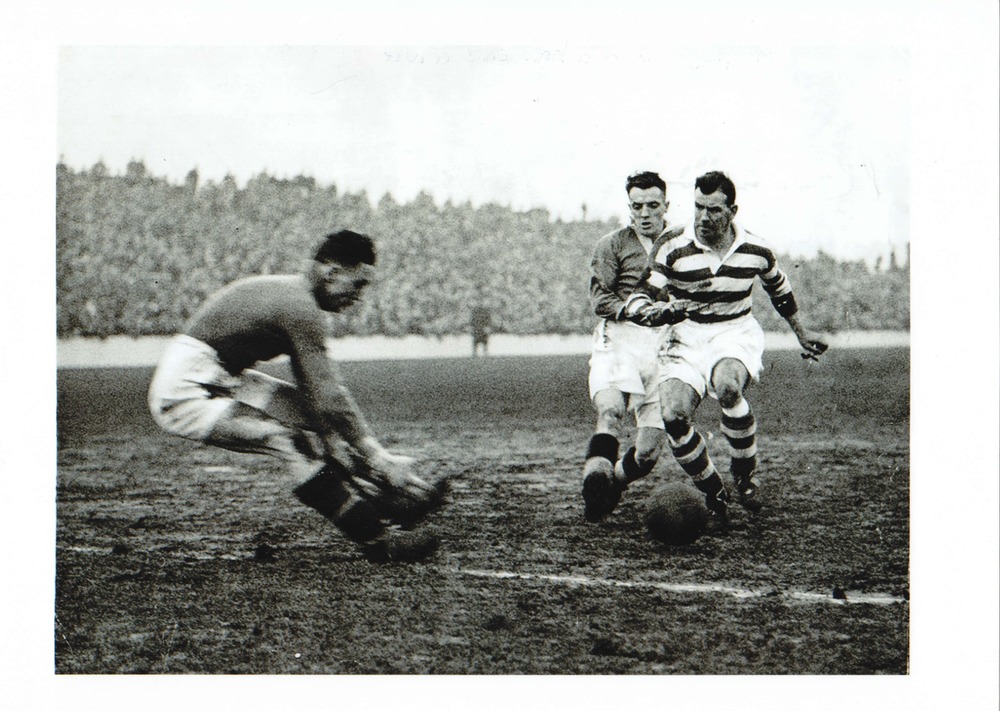
Before that, friends Jimmy McGrory and Jack Connor would come face-to-face again at Broomfield, on Saturday, 7 March 1936. Connor would finally score that elusive goal against Celtic, as early as the fourth minute, putting the home side in front, a lead doubled before the half-hour by Law. The Bhoys would then produce a stunning fightback in the closing thirty minutes, Crum then yet another McGrory double securing a 3-2 win for Celtic against the odds.
Seven days later, Motherwell were the visitors to Celtic Park, as yet more history was created. Goals from Jimmy Delaney and Willie Buchan had Celts comfortably ahead at the interval, before the great man took centre stage. Between the 65th and 67th minute, McGrory had completed a hat-trick, a shot followed by two trademark headers from Frank Murphy crosses finishing the scoring at 5-0.
And on Saturday, 18 April 1936, the Garngad legend notched his seventh and final hat-trick of the season, as Celtic beat Ayr United 6-0 to clinch their first League title in a decade. That took Jimmy’s tally for the campaign to 50, a Celtic club record to this day and a total only ever beaten by Motherwell’s Willie McFadyen, with 52 in their championship-winning season four years earlier. Jimmy actually missed a penalty to make that 51, one of two he missed from only three attempts in his Celtic career. Injury would prevent him making a further attempt to equal or beat the record at Firhill on the final weekend.
The Celtic Wiki suggests that Jack Connor was the second-highest goalscorer in the Scottish top-flight that season, and whilst I am struggling to get definitive numbers to confirm this, his tally of 47 League goals in 70 games across two seasons at Broomfield would make that prospect a distinct possibility. Jack’s goalscoring achievements become even more impressive when you consider that Airdrieonians were actually relegated at the end of that 1935/36 campaign. That two-year period would include a short spell on loan at neighbouring Albion Rovers in 1934, where he scored eight goals in six games.
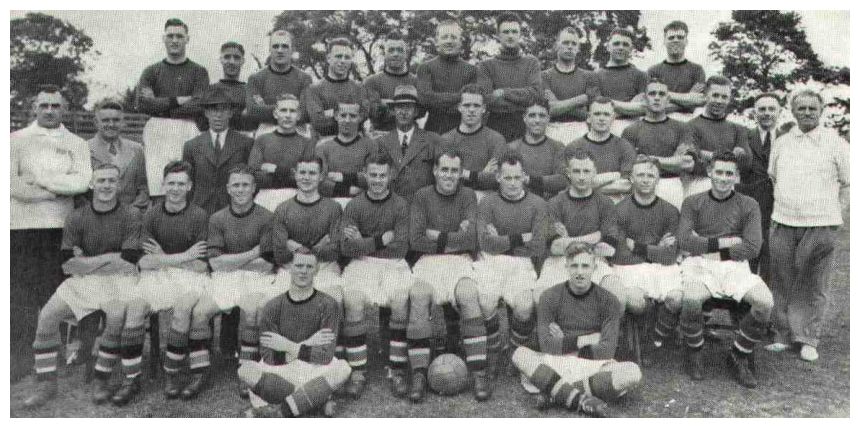
Plymouth Argyle 1937-38
Such prolific form would not go unnoticed. On Saturday, 26 September 1936, having just turned 25, Jack made his debut for English Second Division side, Plymouth Argyle in a home League fixture with Nottingham Forest, scoring twice in a 4-1 win. He would enjoy a successful introduction at Home Park, scoring again a fortnight later as the Pilgrims drew 2-2 with Aston Villa in front of over 43,000 fans in south Devon. Further goals would follow against Norwich City, the now-defunct Bradford Park Avenue, and Sheffield United, before he notched Argyle’s third in a 3-1 victory at White Hart Lane on Saturday, 28 November 1936. Jack continued to find the net with goals against Bury at Home Park then away to Doncaster Rovers, either side of Christmas, as two familiar faces joined him in Plymouth, former Celtic colleagues Tom Ryan and Jim Foley.
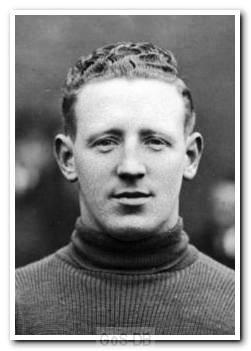
Jim Foley
Irish keeper Foley was the victim of a horrible miscarriage of Scottish justice, following an incident at Tynecastle during a Scottish Alliance match the previous November, which prompted his exit from Parkhead, an episode covered in an earlier part of this series. In summary, despite being headbutted by a pitch-invading spectator, Jim was subsequently charged with assault, tried and convicted in an Edinburgh court, then forced to pay a fine or serve a custodial sentence. Foley would make his Argyle debut alongside Jack Connor in the 1-0 victory over Coventry City on Saturday, 9 January 1937.
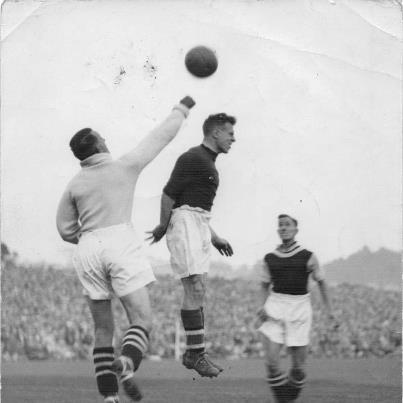
Jack Connor playing for Plymouth Argyle
Jack grabbed both Plymouth goals in the 3-2 defeat at Filbert St, Leicester, two weeks later but failed to find the net as Spurs took revenge for that earlier clash by knocking the Pilgrims out of the FA Cup in north London the following weekend. After missing the next two games, Jack was back with a bang, scoring a double at Villa Park as his side lost by the odd goal in nine, on Saturday, 13 February 1937 then the second as Argyle beat West Ham United 2-0 seven days later. The month ended with another win on the road, Jack hitting the opener as the Devon club beat Norwich City 2-1 at Carrow Road.
The game in East Anglia on Saturday, 27 February 1937 would mark the Plymouth debut of wing-half Tommy Ryan. He had joined Celtic from junior outfit St Anthony’s in 1933 and would feature with Jim Foley and a number of the other ‘periphery’ Celts on the autograph sheet which is the original source of this article, such as John Boyle, Danny Dawson and Willie Hughes.
Tommy would struggle to displace regular wing-halves Chic Geatons or George Paterson, with Hughes and Dawson ahead of him in the queue should either be missing. He would not feature in the first team at Parkhead and moved to Plymouth at Christmas 1936, just a few days before Foley followed. Sadly, Ryan would find the same situation at Argyle, where the long-serving duo Archie Gorman and Tommy Black were automatic picks. He would make just seven starts at Plymouth, before joining Swindon Town in the summer of 1939.