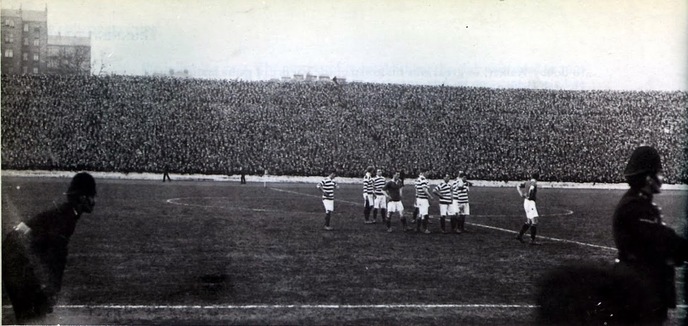
On Saturday, 10 April 1909, a new record attendance of 70,000 turned up to see the Scottish Cup Final between the Glasgow rivals, Quinn heading the Bhoys in front, a lead they held until the 72nd minute. The game then turned on its head within three minutes. Firstly, Tom Gilchrist equalised then the knife was further and cruelly twisted, as Alec Bennett, having won four successive titles and two Doubles with Celtic and having scored the winning goal for the Bhoys at Ibrox in April 1908 before making the switch across Glasgow two weeks later, edged the Govan side ahead.
With time quickly running out, Quinn’s pressure on the Rangers keeper, Harry Rennie, forced him into the concession of an own goal. Rennie had been the hero of Hibernian’s win over Celtic at Parkhead in the 1902 final, however, it would be his error which would take this tie to a second game, and subsequently, into notoriety.
Seven days later, the teams met again. At stake for Celtic was a ‘Treble Double’, whilst the Ibrox club was desperate to break the trophy monopoly of their now fiercest rivals. This time it was Rangers who struck first, through Jimmy Gordon, with the prolific Jimmy Quinn again on the scoresheet for Celts, as the replay finished 1-1. What happened next will forever remain a mystery. Despite the competition rules allowing extra-time only if teams were level after a third match, players of both sides remained on the pitch at the end of the ninety minutes, in anticipation, presumably, of a further thirty.
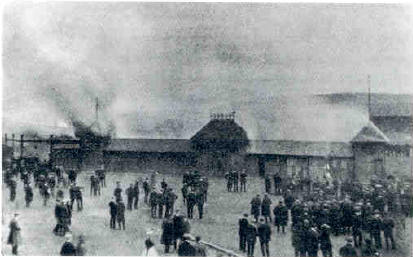
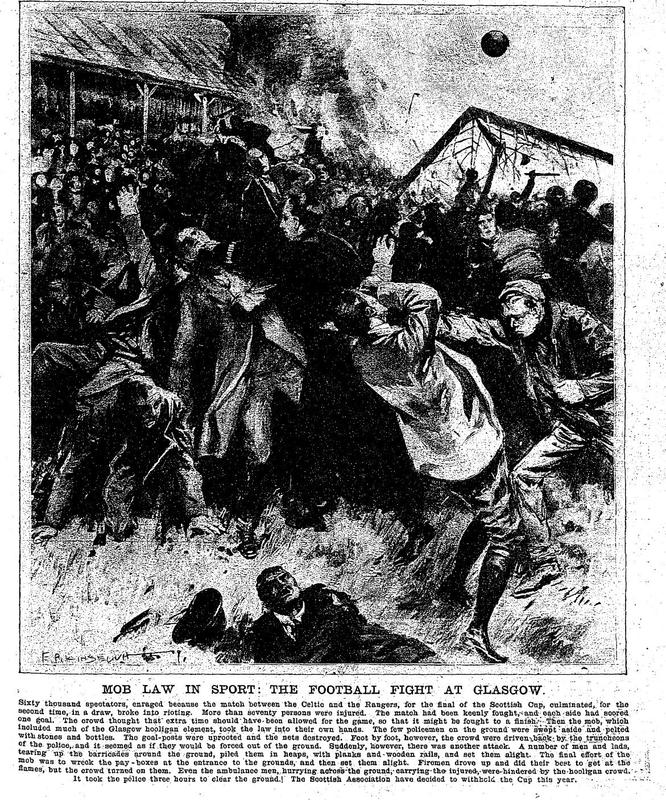
The 60,000 crowd would appear to have been like-minded in their expectation. When it became clear that no such additional period would ensue, all hell broke loose from the terracing, the ‘old firm’ tag coming back to haunt the clubs, with suggestions of conspiracy and commercial collusion abounding. Police and fire service personnel were attacked at random and the stadium itself was quickly under siege, with turnstiles, goalposts and the playing surface set on fire.
The full-scale riot would endure for over two hours, neighbouring properties then finding themselves the target as the mob finally dispersed from the stadium. In the aftermath, both clubs were fined and the cup withheld. There would be no Treble Double and it would be more than a decade before the Scottish Cup Final returned to Hampden.
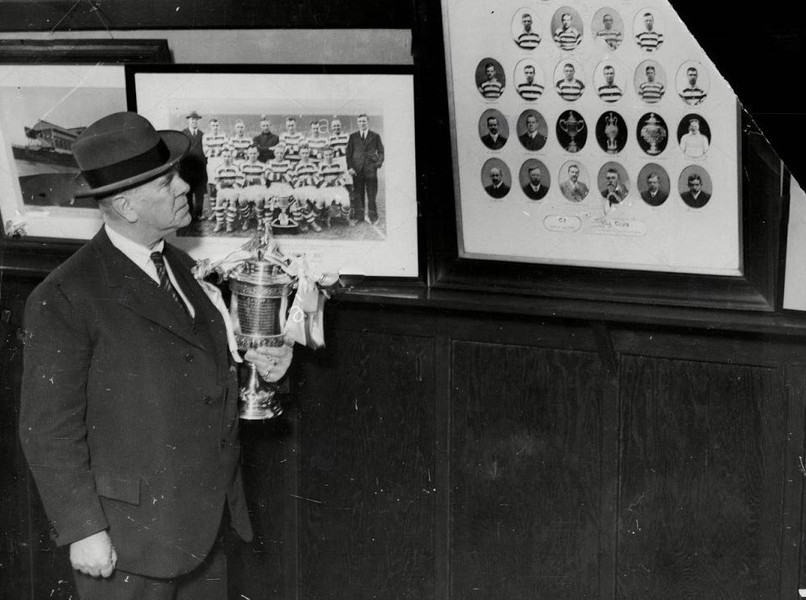
The following year would see a sixth successive title won by Celtic, prompting the presentation of that beautiful shield by the Scottish League, which remains on display in the Parkhead boardroom to this day, although their Scottish Cup hopes would be ended by Tom McAteer’s Clyde in the ‘Leigh Roose’ semi-final at Shawfield, mentioned previously. Quinn and McAteer would then score the goals against Hamilton Academical which took the trophy back to Celtic Park twelve months later, in April 1911.
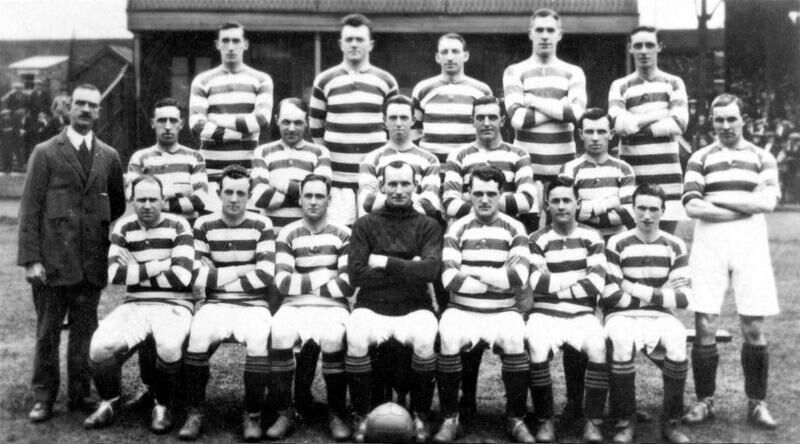
Celtic’s first 6-in-a-row winning side
Thus, when baby John Connor entered the world in September of that year, it’s probably fair to say that Jimmy Quinn would have been the darling of the Celtic support, and therefore, of the Garngad. If James Kelly had been Celtic’s first superstar, and Dan Doyle and Sandy ‘Duke’ McMahon the key Bhoys throughout the 1890’s, then the shy Croy powerhouse would pick up that baton and drive the club forward into the new millennium.
The first Celtic match of John Connor’s lifetime took place two days after his birth, on Saturday, 9 September 1911, a Glasgow Cup-tie against Partick Thistle at Parkhead, goals from Andy McAtee, Jimmy McMenemy and the lesser-known John Brown securing a 3-3 draw. By now, Quinn was 33 years-old and in his twelfth season at Parkhead, however, there was yet more history to be made. On Monday, 1 January 1912, he scored his third hat-trick against Rangers in a 3-0 victory at Celtic Park. Jimmy Quinn was the only player from either club to ever achieve that feat.
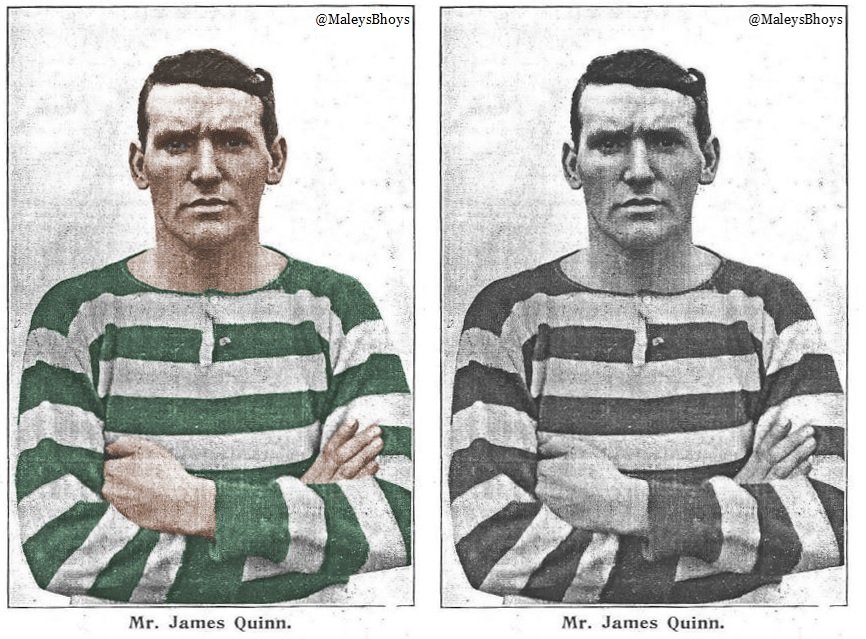
By the time young Connor was starting school at his local primary, St Roch’s on the Garngad Road, the country was at war and the Celtic fans had a new hero to worship. The great Quinn had played his last match for the club on Saturday, 30 January 1915, a 1-1 home draw with Hearts, having featured only sporadically in the previous two years, as Maley’s next great side began their own run of consecutive titles. His place in history was assured, with 239 goals from 369 games in all competitions, 6 successive League championships and 5 Scottish Cup-winners’ medals, Quinn having scored 8 goals in the various showpiece finals since 1901. But now there was a new Bhoy in town, and he was pretty special too.