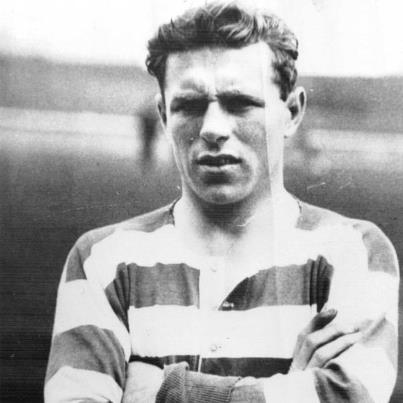
Jack Connor would indeed follow the same career path as Jimmy, from Boys Guild through the junior ranks with St Roch’s then eventually to Celtic. He would have a trial at Parkhead in August 1931, just before his 20th birthday, as the events which would lead to John Thomson’s tragic death at Ibrox were being organised by fate, before signing a permanent contract on 6 June 1932, ten years to the day his old club had lifted the Scottish Junior Cup for the one and only time in their now century of history.
He would witness a mixed start for Celtic to season 1932/33, the Hoops trying to wrestle the title back from Sailor Hunter’s Motherwell and claim the crown for the first time since 1926. Despite a damaging 2-1 defeat by Partick Thistle in August and dropped points against Hamilton Academical, Falkirk and Rangers, a 3-1 victory at Firs Park, Falkirk over East Stirlingshire on Wednesday, 14 September saw the Celts move to the top of the table, albeit having played a game more than their Ibrox rivals, thanks to a second-half hat-trick from Charlie Napier.
Three days later, Celtic made the short trip to Hampden for a League clash with Queen’s Park, with a side showing four changes from midweek. Willie Cook and Peter McGonagle made way for Bobby Hogg and Jock Morrison at full-back, whilst Frank O’Donnell and Jack Connor came in for Jimmy McGrory and Malcolm MacDonald up front. It would be a Celtic first-team debut at inside-left for Garngad-Bhoy Connor, with O’Donnell playing through the middle and Napier wide left, Alec and Bertie Thomson linking on the right flank. Behind that strike force were wing-halves Chic Geatons and the versatile Willie Hughes, either side of captain Jimmy McStay. Joe Kennaway, nearing the end of his first year as replacement for John Thomson, was between the sticks.
It would prove a difficult afternoon for the Celts amongst the 10,000 crowd, O’Donnell providing the only moment of hope with an equaliser just before the interval, as the amateurs ran out comfortable 4-1 winners. Jack would not play again in the first team that season as Celtic finished fourth in the table, ten League defeats leaving them a distant fourteen points off champions Rangers and behind both Motherwell and Hearts. They did regain the Scottish Cup with a second-half Jimmy McGrory goal against the Steelmen at Hampden, a second such triumph in three years against the same opposition.
By that time, Jack had enjoyed a very productive spell on loan with Airdrieonians, scoring 22 goals in just 21 League games for the Diamonds that season, despite the Lanarkshire side fighting relegation throughout, a battle they would win but only just. He would be in his preferred centre-forward role at Broomfield on Saturday, 3 December 1932, when he faced his parent club for the first time, a Bertie Thomson double either side of a Charlie Napier spot kick conversion giving Celts a commanding lead they would not relinquish, despite Connor securing a late penalty for the hosts which McQueen then contrived to miss, as Airdrieonians slumped to an eighth successive defeat.
Jack would also feature in the return League fixture, played at Celtic Park on Tuesday, 18 April 1933, just three days after the Bhoys had beat Motherwell 1-0 in the Scottish Cup Final mentioned above. Maley had made three changes to his cup-winning line-up for the last home match of the campaign, Joe Kennaway, Jimmy McGrory and Charlie Napier making way for Jock Wallace, Frank O’Donnell and debutant George Paterson, the latter appearing at centre-forward and opening the scoring with a header which went in off both post and keeper Morrison, ten minutes before the interval.
George would later be converted into one of Celtic’s best ever wing-halfbacks. Five minutes after the restart, it appeared to many onlookers that Jack Connor had scored an equaliser for Airdrieonians, goalkeeper Wallace scrambling frantically to clear his effort from the foot of the post. Controversially, referee Baillie chose to play on and the Lanarkshire side would then go on to concede the next goal, Alec Thomson netting with fifteen minutes remaining. Morrison did pull one back for the visitors in the dying minutes, however, the 2-1 defeat meant their battle to stay up would go to the wire. Despite losing both of their final games, away to Ayr United then home to St Mirren, the Diamonds would survive by two points, Morton and East Stirlingshire taking the dreaded drop. There is no doubt that Jack Connor’s 22 goals were crucial in prolonging their stay in the top-flight and he would have returned to Celtic Park that summer with high hopes for the season ahead.
Celts would make an indifferent start to the following season’s campaign, newly-promoted Queen of the South winning 3-2 at Palmerston on the opening day, their first-ever top-flight match and Willie Buchan’s Celtic debut, then the Hoops and Falkirk sharing four goals at Parkhead, with Bob Shankly scoring an equaliser for the Bairns, a game famous for the referee blowing prematurely for full-time as Celtic desperately chased a winner. He would then be forced to call the players back from the dressing-room to complete the match. Quite bizarre. Celts would finally register a victory at the third time of asking, at Firhill in midweek, goals from Jimmy McGrory, Johnny Crum and Frank O’Donnell failing to tease a response from a Partick Thistle side featuring the great Adam McLean at outside-left.