

Modernisation and why Celtic should accept premise of the question

Celtic v BSC Young Boys, view of Paradise from the sky. Photo Vagelis Georgariou
In our earlier articles, we looked at Celtic’s long-term football strategy and the club’s lack of accountability in transfer dealings. What emerged was a picture of a club content to audit itself, explain its shortcomings through “market dynamics,” and set its own bar for success.
The discussion around modernisation, and Celtic’s repeated failure to prepare for European competition, only reinforced that image. Beneath the corporate language of “progress” lies a structure that feels increasingly static, reactive, and opaque.
When asked how Celtic intend to modernise the club’s structure to genuinely compete in Europe, CEO Michael Nicholson’s immediate response was, “The Club does not accept the premise of the question.”

Celtic Director Brian Wilson with CEO Michael Nicholson at Rugby Park, Kilmarnock v Celtic, 14 September 2025. Photo Vagelis Georgariou (The Celtic Star)
That was perhaps a telling moment, and one that said more about Celtic’s mindset than perhaps any carefully worded answer could. Supporters had posed a question in good faith, one grounded in years of frustration over the club’s repeated unpreparedness for European qualification. For the chief executive to dismiss the very basis of that question came across not as confidence, but as complacency. It suggested a leadership team unwilling, or perhaps unable, to engage meaningfully with criticism.
If communication is a key skill of leadership, and in football, where fans are both the lifeblood and the customer base, it absolutely is, then Celtic’s CEO continues to look uncomfortable in that space.
The seven questions submitted by supporters ahead of this meeting had already gone unanswered for weeks. There has been no proactive communication via the club’s own channels, not even a straightforward Q&A through Celtic TV. When the opportunity finally came to provide substance, the message instead was: “I don’t accept the premise.”

Peter Lawwell, Michael Nicholson and Chris McKay watch on during the Scottish Gas Scottish Cup Quarter-Final match between Celtic and Hibernian at Celtic Park on March 09, 2025. (Photo by Ian MacNicol/Getty Images)
That is not leadership. It’s deflection. And it betrays a worrying disconnect between the executive office and the people who keep the lights on.
Nicholson did, however, point to some examples of progress. The appointment of Paul Tisdale as Head of Football Operations and Shaun Maloney as Professional Pathway Manager were cited as key steps in modernising Celtic’s football structure. On paper, both roles could be valuable.
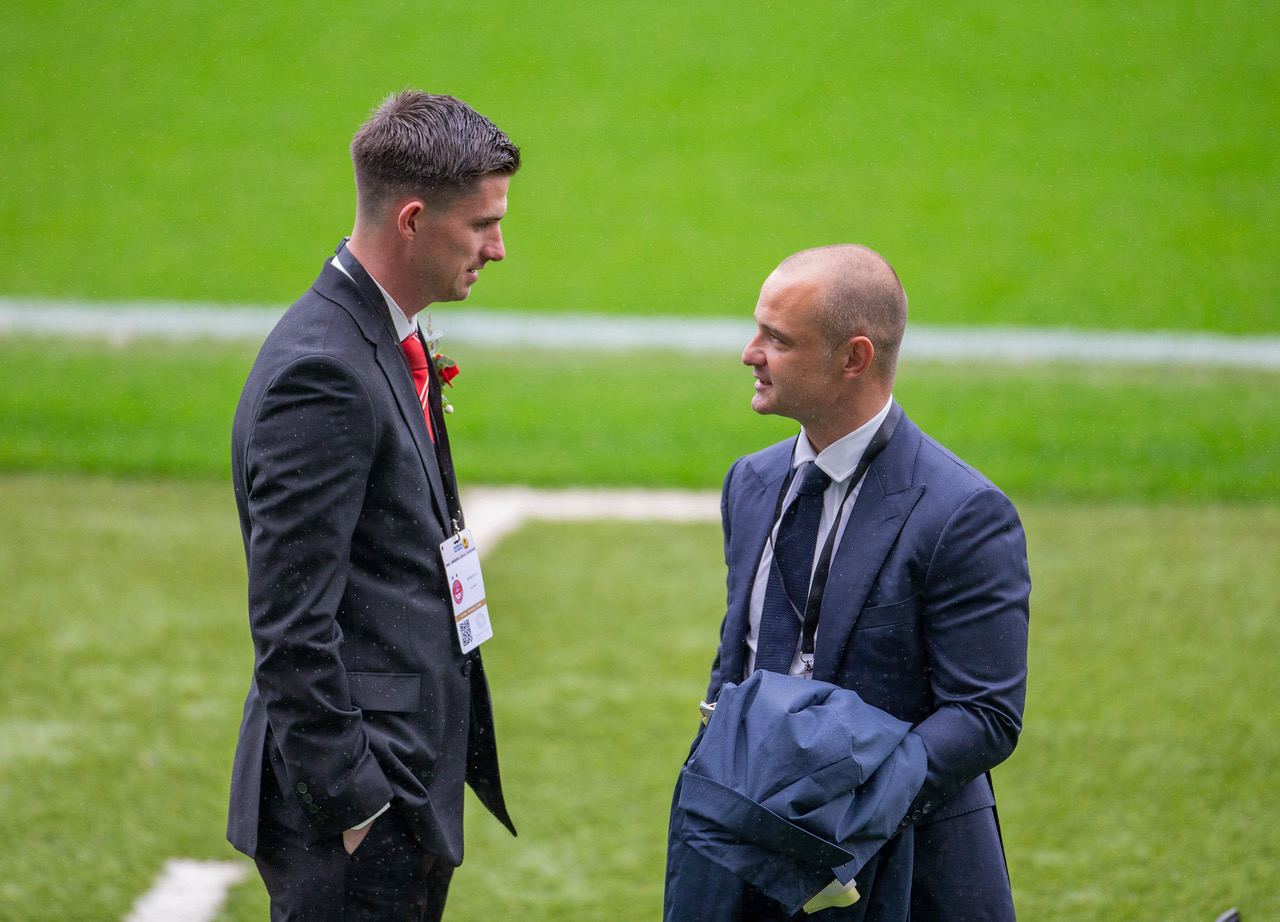
24th May 2025; Hampden Park, Scottish Cup Football Final, Aberdeen versus Celtic; Ross
Doohan of Aberdeen chats to Shaun Maloney ActionPlus Vagelis Georgariou
A Head of Football Operations should, in theory, provide strategic oversight across recruitment, development, and performance. A Professional Pathway Manager could help bridge the long-criticised gap between the academy and the first team.
But these roles are only as effective as the structure around them, and that is where the doubts begin. Supporters are yet to see any coherent explanation of how these new positions fit into a broader plan. Are they part of a clearly defined model, or simply patches on a quilt? Were they created as part of a rigorous restructuring process, or as ad-hoc appointments in reaction to criticism? The lack of transparency fuels scepticism, and with good reason.

Paul Tisdale, manager of Exeter City prior to the Emirates FA Cup Second Round Replay between Exeter City and Forest Green at St James Park on December 12, 2017. (Photo by Dan Mullan/Getty Images)
Fans at the meeting asked how Tisdale was appointed and whether an external recruitment process had been conducted. CFO Chris McKay confirmed that no consultancy was used and that the club had simply “spoken to several candidates.” Nicholson added there were no family or business connections between Tisdale and Celtic board members, though he admitted “individuals had crossed paths previously.”
That may well be innocent, football is a relatively small world, but when the club’s mantra is “world class in everything we do,” a process that sounds more like a friendly conversation than an exhaustive global search does little to inspire confidence.
Supporters also raised legitimate concerns about youth development, particularly the loss of academy players to English clubs. Nicholson attributed this to Brexit, arguing that the post-Brexit landscape has “locked” Scotland into the English market and increased cross-border movement.

Mid-season Friendly, SuperValu Pairc Ui Chaoimh, Cork 8/7/2025 Cork City vs Celtic Celtics Callum Osmand shoots at goal Callum Osmand shoots at goal 8/7/2025 Photo INPHO/Ken Sutton
While there’s absolutely truth in that, it also felt like another instance of Celtic explaining the problem rather than demonstrating how they’re overcoming it. Every club in Scotland faces the same challenge, the difference is how you adapt.
More revealing, though, was the discussion around how transfers are actually conducted at Celtic. McKay described a “multi-disciplinary approach,” led by the football department in identifying players and finalised by the executive team.
On the surface, that sounds pretty standard. But the details perhaps expose an outdated and cumbersome process. Supporters learned that for transfers above certain thresholds, approval must come from the Celtic plc Board — via email. In theory, this ensures fiscal oversight. In practice, it risks paralysis.
Modern football is a fast-moving marketplace. Clubs that operate with agility, able to make decisive, informed moves, succeed. Those bogged down in corporate approval cycles miss opportunities.
If Celtic’s board needs to sign off on player valuations by email before deals can be closed, then the club is operating with a 20th-century model in a 21st-century game. A director of football working within an annually approved budget would be a far more efficient and professional structure. What Celtic currently have sounds bureaucratic and reactive, the polar opposite of the world-class agility they like to reference.

Celtic Manager Brendan Rodgers during the Scottish Premiership match between Celtic FC and Motherwell FC at Celtic Park, on 5th October 2025. Photo Mark Runnacles IMAGO/Shutterstock
Then there was the now-infamous moment when Nicholson was asked why the manager had referred to some arrivals as “club signings.” His response, a shrug of the shoulders, has already become emblematic of the disconnect between the football department and the executive team. It was a gesture that spoke volumes, a public admission, intentional or not, that the boundaries of responsibility are blurred and that accountability is diffuse.
For supporters, it may have reinforced the suspicion that the manager’s influence in recruitment is limited, that he may sanction signings but doesn’t necessarily shape the strategic direction. When those signings fail to perform or when the squad remains unbalanced, responsibility becomes conveniently shared, which is to say, borne by no one.
The issue is not that Celtic lack capable people. The issue is that those people operate within a structure that feels improvised, dated, and opaque. A club that claims to be modern and data-driven should not rely on email chains for transfer approval or personal networks for senior football appointments. Modernisation is not about adding titles, it’s about redefining processes, accountability, and communication.
And yet, despite repeated European failures, Celtic continue to act as if the model doesn’t need fixing. Nicholson’s refusal to even entertain the premise of the question, ‘why are we consistently unprepared for qualification stages?’, perhaps actually captures the essence of the problem. It is not just that Celtic fall short in Europe. It is that those leading the club seem unwilling to admit that they do.
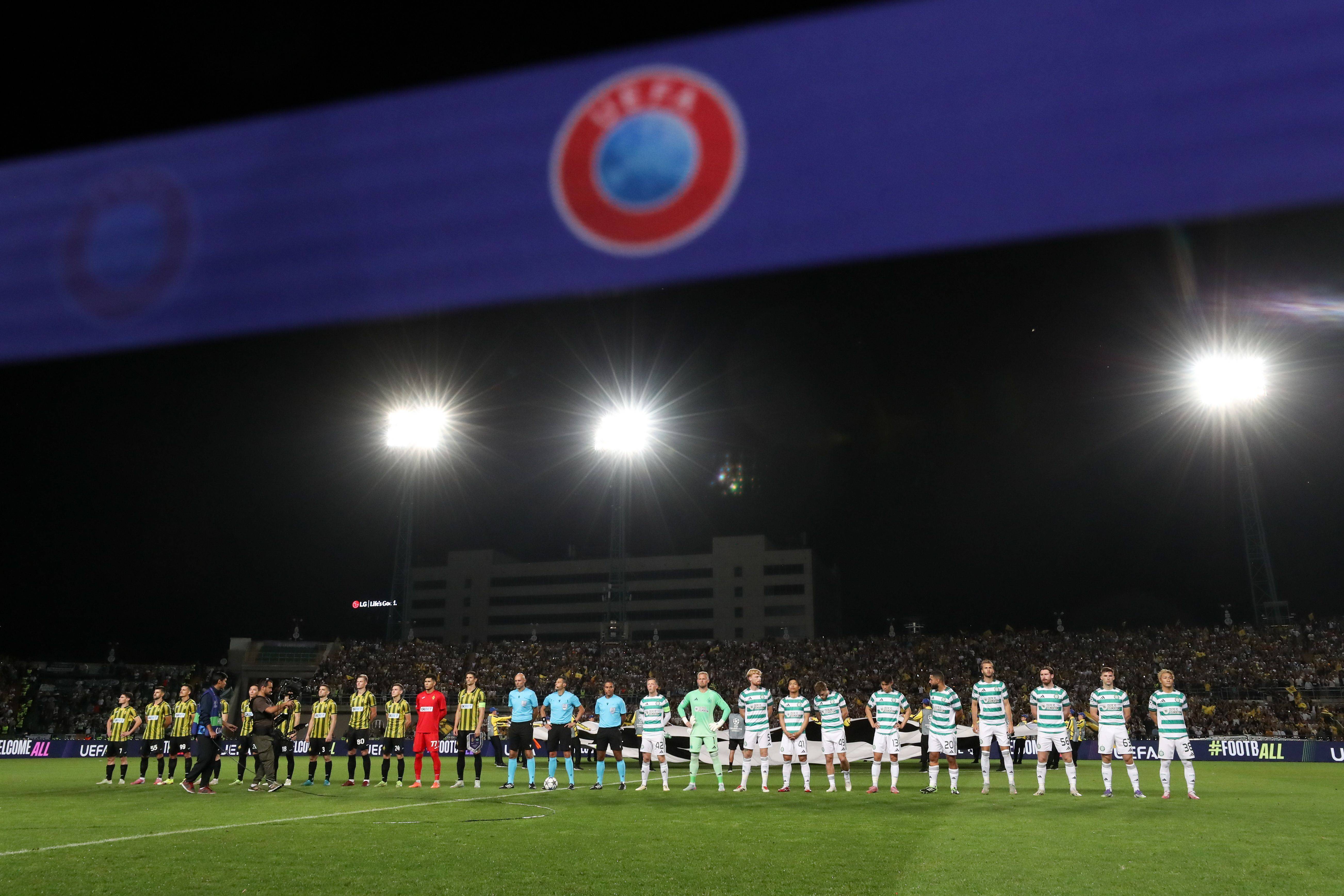
Celtic and Kairat Almaty line ups Kairat Almaty v Celtic, UEFA Champions League, Play-Off Round, Second Leg, Football, Almaty Central Stadium, Almaty, Kazakhstan – 26 August 2025. Photo Anikita Bassov Shutterstock
A world-class club doesn’t shrug its shoulders when asked about “club signings.” It doesn’t conduct senior appointments through informal conversations. And it doesn’t email board members for permission to complete transfers. It identifies what is broken, fixes it, and communicates that clearly to its supporters.
Until Celtic start doing that, the word ‘modernisation’ will remain what so much of the club’s rhetoric has become, another empty phrase in a corporate dictionary of good intentions.
Niall J




Very well written piece…thank you…Cutting to the chase, I am of the opinion that KERCHING is the driving force behind just about everything the Board does…Decisions that help making money are backed up by decisions chosen not to lose money…It’s all they care about… I wish FAB all the best with their endeavours…but don’t hold out much hope.
Well written my eye! Niall J, you aee a disgrace!
Michael Nicholson DID NOT SAY THE CLUB ARE “WORLD CLASS IN EVERYTHING WE DO”
Yet it is your 100% inference! Why would you do this if not to cause more damage and harm? Why leave out the first, and MOST IMPORTANT PART OF THE SENTENCE?
“OUR AIM IS TO BE”, but instead, you wrote it as if it was, his complete statement!
People like you are a big part of the problem!
You are an embarrassment!