The final between the Glasgow rivals went ahead as planned on Tuesday, 17 June 1902, at the original Cathkin Park, off Crosshill Road in Govanhill. This was the home of Third Lanark until they moved to the second Hampden the following year, which they later renamed as New Cathkin, and where they remained until their sad demise in 1967.
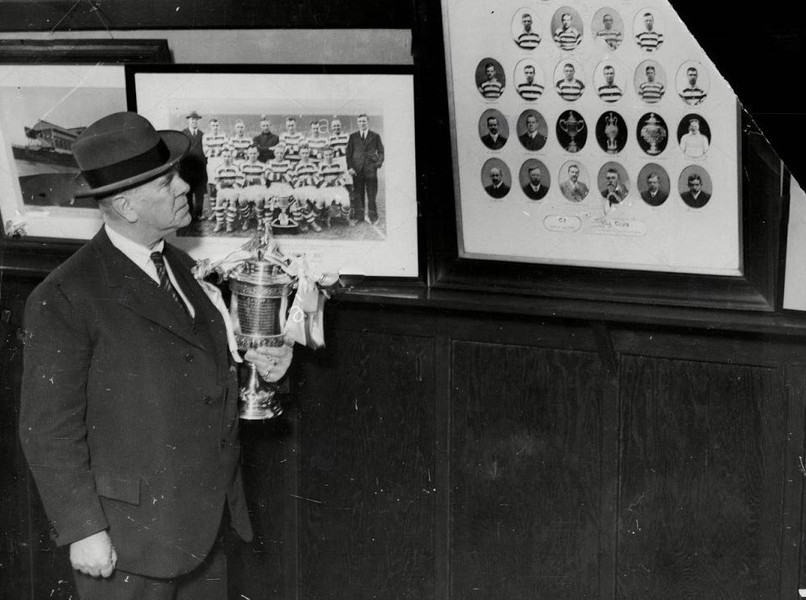
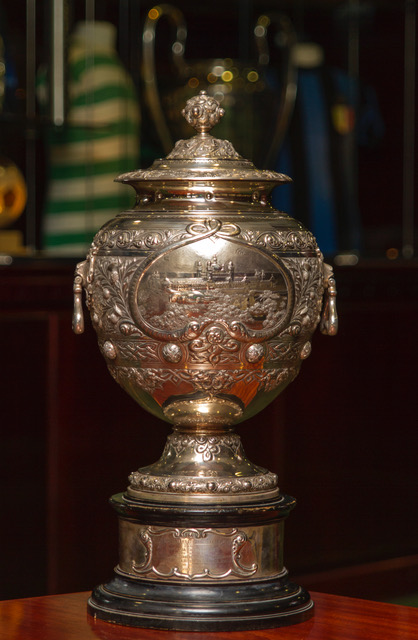
Jimmy Quinn scored twice to give Celtic a commanding lead, only for Robert ‘RC’ Hamilton and Finlay Speedie to equalise before the interval. With no further scoring in the second half, it was agreed to play two periods of ten minutes each as extra-time. Some journalists had already left Cathkin and would later record the match as a 2-2 draw, before Quinn added a third goal following a Celtic corner, with just thirty seconds remaining, to win the British League Cup. The beautiful trophy remains in the Parkhead boardroom to this day (see above) and is unique in the sense that it was never engraved to reflect Celtic’s success.
Jimmy Quinn, thus, became the first Celt to score a hat-trick against Rangers in a competitive game. Tom Maley had claimed three goals in Celtic’s first-ever game, fourteen years earlier, the 5-2 win on Monday, 28 May 1888, however, that match was deemed as a friendly, with the opposition listed as ‘the Rangers Swifts.’
History and Quinn would continue to walk hand in hand. Just over a year after that victory at Cathkin, Jimmy would again be on the left-wing as the first Celtic side ever to wear the now-iconic Hoops took the field, for a home League game with Third Lanark on Saturday, 29 August 1903. Prior to that, Celtic had worn a white jersey for their inaugural season, then the vertical green-and-white kit we would come to associate with Real Sociedad. That’s another story for another day. And two months later, on Saturday, 31 October 1903, he would feature in the Celtic team which opened ‘New Hampden Park’, Queens’ Park, having relocated from Second Hampden (better known nowadays as Cathkin Park, the final home of Third Lanark), celebrating the occasion by beating their neighbours 1-0 in a League game.
And although the Bhoys would finish that campaign in fourth spot, as Third Lanark secured their first and only League title, Quinn and his Parkhead teammates would end the 1903/04 season on a high. Having scored the goal which beat the champions-elect Thirds in the home Scottish Cup semi-final on Saturday, 19 March 1904, Jimmy Quinn lined up at centre-forward for the final against Rangers four weeks later.
Saturday, 16 April would be his date with destiny. The game is widely recognised as being the first where the description ‘old firm’ was used to reflect the financial benefits to be gained by both clubs from the developing rivalry, a term which would endure for over a century, before the Ibrox club entered liquidation in the summer of 2012. Missing from the Rangers ranks was the aforementioned RC Hamilton, who would score 35 goals against Celtic, more than any other player in their history.
A crowd in excess of 64,000 packed into Hampden, for the first Scottish Cup final to be held in the new Mount Florida arena, the Govan team seizing the early initiative with a Finlay Speedie double. By half-time, the Mighty Quinn had drawn Celtic level with his own brace, and he would have the final say, powering through the Ibrox defence to score the winner as the clock ticked down, his second hat-trick against Rangers. And seven days later, Jimmy would score five of Celtic’s six goals as they beat bottom-dogs Kilmarnock 6-1 at Parkhead in the final League game of the season. A new Celtic Star was born.
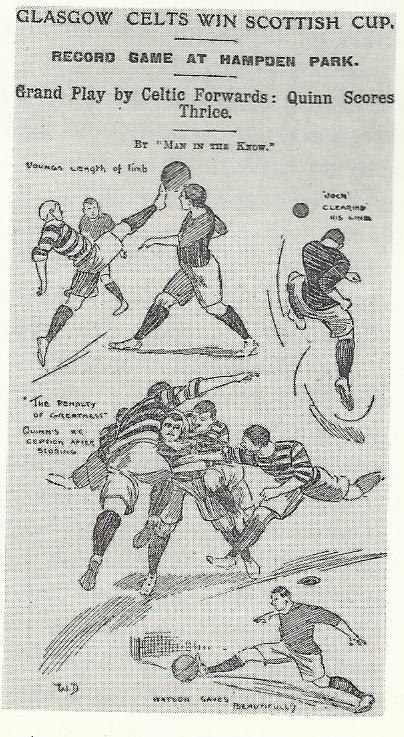
Quinn would then lead the line as Maley’s Bhoys dominated Scottish football over the next six seasons, completing six-in-a-row, whilst ‘making those doubles’ in 1907 and 1908, with Scottish Cup Final wins over Hearts, revenge for 1901, then St Mirren, with Jimmy on target in the 5-1 victory over the Paisley outfit in April 1908. Celtic would then face Rangers in the final twelve months later, chasing a third successive triumph. It is a contest which remains infamous to this day, known as the Riot Final.