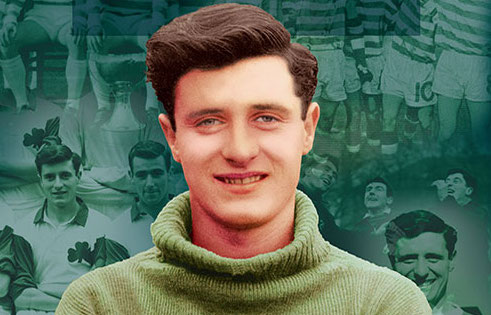
We next find Charlie Gallagher playing for the Scottish Amateur League against the Airdrie and Coatbridge League at the odd venue of Cowal Park, Dunoon on the equally strange date of 28 June 1958. But then
again, in the same way that they say that the city of New York never sleeps, the Scottish football season never really stops either. Indeed, the full Scotland team had just returned with their tails between their legs
from the World Cup in Sweden after three awful performances against Yugoslavia, Paraguay and France.
The failure to appoint a Manager for Scotland betokened the amateurish approach to all this. Effectively the team was run by senior players like Tommy Younger of Hibs and Bobby Evans of Celtic – fine players both, but something more was required. The good side of the 1958 World Cup however was the fact that it was shown on TV (something that more and more people now aspired to owning) and we were able to see the fabulous Brazilians including the emergence of a superbly talented youngster called Pele, Older Celtic supporters scoffed however and said “You never saw Patsy Gallacher!”, but it would have to be admitted that Pele was not a bad player.
But returning to this game “doon the watter” at Dunoon, Charlie Gallagher starred, sending a nice through pass to Ian Lochead to score the first, then he scored himself before contributing to the third goal scored by Robert Burns of Drumchapel. The team won eventually 5-2, and Gallagher’s performance was noted, not least by those in important places at Celtic Park.
Charlie was lucky in one regard in his private life. He was just young enough to avoid National Service. Following the end of World War II, the Government (a Labour one, to its shame) decided that young men should be conscripted into the Armed Services for a limited period of time (usually 18 months to 2 years). This involved training in England usually and then often a posting overseas to Aden or Cyprus or Singapore, for example.
There were good things about it in that it allowed young men to see a bit of the world, and there are even those today who say that it would be a good thing to instil discipline etc. There were exemptions if you worked in
various jobs, and you could always apply for a deferment, a postponement of the inevitable, so that you could finish an apprenticeship for example.
But behind all the guff about “making a man out of you” “defending the realm” and “serving the Queen”, the fact remained that it was compulsory and looked upon with dread and horror by those who were taken away from their comfort zone. It played havoc with careers and romances, and frankly, it became harder and harder to justify every year that passed. It would finish altogether in the early 1960s, but in 1957 it was decided that all those born on or after October 1 1939 would not necessarily be called up. The sigh of relief was audible throughout the land, not least from young men like Charlie Gallagher.
In 1958, the Army did not as yet engender the same feelings of hatred in the Glasgow Irish community as it does today, but it is hard to imagine a peaceful man like Charlie Gallagher enjoying life in the Army. On the other hand, the Army did encourage football and would often stretch a point or two to allow a soldier home for the weekend to play in a game, for example. Men like Ronnie Simpson, Steve Chalmers and Jim Kennedy all served their time in the “sodgers” and claimed that it had benefitted them.
On the other hand, very few men evinced any desire to stay on after their period of compulsory service had expired.
In August 1958 Charlie signed for Yoker Athletic, a Junior team based at Holm Park, Clydebank. They played in the Central League and various Cup competitions against teams like Johnstone Burgh, Vale of Leven,
Petershill, Port Glasgow and Ashfield, and Charlie distinguished himself, so much so that a month after the start of the season, he was signed for Celtic on a provisional basis in October 1958, something that allowed him
to continue to play for Yoker. He played in several positions during the 1958/59 season – at outside right, inside right and inside left.
He was already a Celtic provisional by the time that he played his best game for Yoker, and that was in the Dunbartonshire Charity Cup final at Holm Park against Vale of Leven. Vale of Leven is of course a name
embroidered on the very fabric of Scottish football, for they were very much involved in the early years of the game. A good quiz question would be “What have Vale of Leven done with the Scottish Cup that Celtic
haven’t?” And the answer of course is that they won the trophy three years in a row – 1877, 1878 and 1879 – something that Celtic have yet to achieve (at the time of writing in 2016). Celtic have come close. In the early 1970s they won it 4 years out of 5, and in 1909 only the Hampden Riot prevented them, but they have
yet to win the Scottish Cup three years in a row (Puts a Quadruple Treble into some context too, folks).
All this was in the dim and distant past as far as Vale of Leven were concerned in 1958, when they were ripped apart by Charlie Gallagher in a 5-2 defeat. The Scottish Sunday Express is quite emphatic in its admiration “Star of the Dunbartonshire Charity Cup final was Yoker’s teenage right winger, Charlie Gallacher (sic – wrong spelling!). Lucky Celtic – they have him already signed. Gallacher scored two snappy goals in the first half and was always a menace to the Vale of Leven defence. He formed a tip-top right wing with Bobby Dougan, playing his first game for Yoker.”
He also starred as Yoker beat Rob Roy 5-0; “a powerful shot from 18 yards” helped Yoker beat Ashfield (who were without their bright star that day – one Stephen Chalmers); equalised with a “rocket shot” against Renfrew, and “headed an equaliser” against Johnstone Burgh – all this was enough to convince the Glasgow journalists that there was future in this boy. Less creditably, he picked up what he claimed to be his first and only “booking” in his career at Junior or Senior level when he deliberately tripped up a Petershill player.
Playing a season in Scottish Junior football is character building for anyone. The term itself is misleading. A “junior” need not necessarily mean a young man. Some gnarled old veterans plied their trade in the
junior ranks. Often the players were young men, as Charlie Gallagher was in season 1958/59, but sometimes “juniors” were men who had not made it to the senior ranks, or sometimes men who had been seniors and had
returned after perhaps an injury or simply not managing to fulfil their potential.
It is generally agreed that Scottish Junior football is tough. Pitches are not always great with a marked lack of grass on occasion, crowds are small but rabid with every team having its own band of enthusiastic supporters.
Tackles are hard and winning is as important as it is to the full-time professional, maybe even more so, for there is not the consolation of the money – at least not a great deal of money. Paying players is generally
frowned upon, but it does happen!
There is also the factor of weather. Seldom in a Scottish winter does one get an ideal day for a game of football. Either the pitch is bone-hard, or the opposite is the case, where the pitch resembles a quagmire – but tough
players are happy to play on any surface. There was also in Glasgow in the 1950s in particular, an additional problem which has now diminished – that of fog or “smog”. Fogs and mists do still happen today of course,
but before governments got concerned about clean air, an Atlantic mist could join forces with the polluted air of Glasgow’s industrial waste and cause a fog that could last for days, bringing untold misery and loads of
health problems.
A thick skin is necessary in Junior football, for players hear every word hurled at them. In a large crowd, individual comments can be drowned in a wall of sound. In a crowd of a couple of hundred, every insult direct by some cretin at your father, your girlfriend, your religion is heard! And it is often claimed that the bravest men in the world are those courageous enough to referee such games. A crowd at a Glasgow Junior game is far more intimidating than Celtic v Rangers, for there a referee has a couple of linesmen to help and a huge amount of policemen. At a Junior game, anything can happen – and the referee is on his own.
That, incidentally, was the opinion of Jack Mowat, arguably Scotland’s best ever referee. He was in charge of many Cup finals in the 1950s, including famously the European Cup final at Hampden in 1960 between Real Madrid and Eintracht Frankfurt to which, it was claimed, that he walked from his house in Rutherglen! Jack would always say that once you have done the Glasgow Juniors, you are afraid of nothing!
Charlie Gallagher thrived in this atmosphere. He did not look the toughest of characters, and boasts of his virtually unblemished record as far as referees and discipline went. He was able to ignore provocation and
nasty tackles from the likes of Bobby Shearer of Rangers, and he learned this in his year with Yoker Athletic. Above all else, he continued to enjoy his football. He was interested in very little else and lived for his next
game. He was happy enough to play wherever he was put. Modest and unassuming he may have been, but he knew that he had a certain amount of talent, and he always enjoyed the chance to put it to the test.
David Potter
From David Potter’s 2016 biography, Charlie Gallagher? What A Player!
Everyone at Celtic Football Club is extremely saddened at the death of a true Celtic great, Charlie Gallagher.
Our thoughts and prayers are with Charlie’s wife Mary & the entire Gallagher family.
Rest in peace, Charlie. You'll Never Walk Alone 🦁🍀
— Celtic Football Club (@CelticFC) July 11, 2021
To be continued…