The bad weather of January and February 1972 affected the Sons more than any other team, for the weather was rainy rather than frosty, something which had an adverse effect on the appropriately named Boghead. But sometimes a fixture pile up can help a team and some teams, in the months of March and April once the weather turns a little better, can prosper once they play a game in midweek and then on the Saturday. The games come thick and fast, and players thrive as they never get bored waiting for the next game. Older players, far from being tired by their exertions, do all the better for they have the experience to know how to pace themselves, something that is occasionally lacking in younger men. The Sons Of The Rock history of the club is at pains to stress the value of the two experienced Old Firm players of Davie Wilson and Charlie Gallagher. “Neither was in the first flush of youth, but they used their brains rather than their legs to rally their troops for the final assault”.
The second half of the 1971/72 season saw troubled times for Great Britain. The end of January saw the major incident in Ireland known as “bloody Sunday” when the British Army managed to gun down unarmed protesters, but there was also a major coal strike with effects on electricity supply and power cuts. When it happened again in 1974, Sunday football was allowed as a side-effect of it all, but the 1972 strike (so unnecessary and able to have been stopped at an earlier stage through negotiation) inflicted a great deal of damage on the Conservative Government who were forced to surrender. But that was only the first round, as it were. A great deal more had yet to happen in future years.
Raith Rovers put the Sons out of the Scottish Cup in February. One has to be very wary of statements like “a Cup exit gives the team more of a chance to concentrate on the League” but in this case it happened to be true. In March, the team started to play really well, and took revenge on Raith Rovers for the two defeats inflicted on them earlier this season with a sparkling 5-0 victory on 18 April 1972 in which Kenny Wilson scored all five goals.
But then Dumbarton wobbled and were heavily dependent on Gallagher to win 1-0 at Alloa and 2-1 at Brechin City as Kenny Wilson’s goals began to dry up. Then on Saturday 29 April, when promotion might have been secured at home against St Mirren and TV cameras paid a rare visit to Boghead to join the huge 9,000 crowd, Gallagher scored yet again from the penalty spot to put the Sons ahead. But then sadly defensive frailties conceded two goals and put a serious spoke in Dumbarton’s chances of both the Championship and promotion.
Celtic supporters in the area went to that game rather than to their own game at Tynecastle where there had been complaints of discriminatory treatment, and in particular the parking of buses a huge distance away from the ground. They made a good choice going to see Dumbarton v St Mirren for Celtic, the League having been comfortably won two weeks ago, went down 1-4 to Hearts, an extremely rare occurrence in 1972!
The position had been complicated for the past few weeks, but Dumbarton now had a game in hand – an advantage gained from having had so many games called off in the winter – and that was against lowly Berwick Rangers at home. Things were now simple. Dumbarton were two points behind Arbroath but had a far better goal average. This produced the very simple formula that a win would get both the Championship and promotion, a draw simply promotion in second place behind Arbroath and a defeat would bring nothing at all, the beneficiaries to be Stirling Albion.
9,000 came to Boghead on Wednesday 3 May 1972. In some ways it was a historian’s dream. It was their Centenary Year for they were founded in 1872, and halfway through these hundred years had been 1922 when Dumbarton had been relegated to the Second Division where they had stayed ever since. It was a great occasion with Charlie’s two thunderbolts from a distance, one in each half, contributing to the 4-2 victory. The scenes at the end were a sight to behold and even a revelation for Charlie Gallagher and Davie Wilson, both of whom thought they had seen it all with Celtic and Rangers.
Bob Patience of the Daily Record was more than a little impressed. “… the man who can have the freedom of Dumbarton this morning is ex-Celt Charlie Gallagher. It was Charlie who laid on Dumbarton’s opening third minute goal for winger Peter Coleman. It was Charlie who took the pressure off with a spectacular goal after Englishman Jerry Coyne had equalised. And it was Charlie who finally paved the way for a night of sheer nostalgia with an equally great third goal in the 57th minute. Little wonder a “delirious” Jackie Stewart said later “Charlie was magnificent as he had been throughout the last few matches. He pulled us up by the bootlaces tonight. What a player! What a team! What a night!” Quiet hero Gallagher said simply “One of the greatest nights of my life. At Parkhead we were expected to win. This is something different. It’s just great.”
If 1968 had been Gallagher’s Championship for Celtic, the same could be said about this one for the Sons of the Rock in 1972. He scored 19 goals, 9 from the penalty spot and another few from free kicks outside the box, but there was so much more than that for it was he who made all the ammunition for Kenny Wilson and Roy McCormack. He was recognised now as one of the best kickers of a dead ball in British football with his corner kicks particularly accurate and sharp. A future in the First Division now beckoned for Dumbarton, and Charlie would be part of it once more. Summer 1972 was a particularly satisfying one for Charlie Gallagher and his young family.
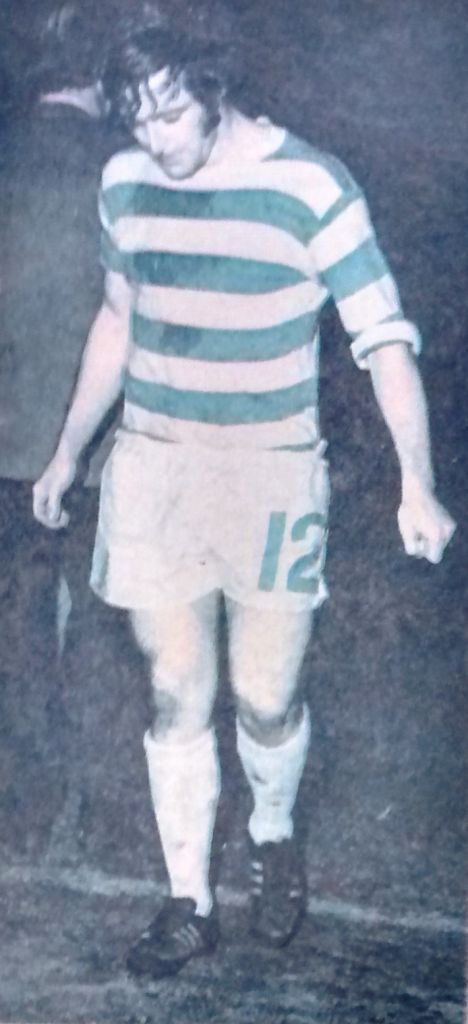
And where were Celtic at this point? A mixture of good and bad it would have to say, with most of it good, some of it outstandingly good. The Scottish League had now been won for the 7th time in a row, beating the team’s own record from 1905-1910, but the end of the season centred on the controversial Dixie Deans. Dixie had been bought in October after the loss of the League Cup final to Partick Thistle, and had been a great success. But he had had the misfortune to be the only player to miss a penalty kick in penalty shoot-out of the European Cup semi-final against Inter Milan. Almost immediately however he bounced back and scored a hat-trick in the Scottish Cup final, something that only Jimmy Quinn had done before!