In the course of the 1972/73 season Charlie Gallagher celebrated his 32nd birthday and now in the First Division, he would find the sheer pace of the game a little too quick for him. Never the fastest of players in the first place, he decided that summer 1973 was a good time to hand up his boots. He had his moments for the Sons in that final season. To begin with there was another visit to Parkhead in the first round of the Dryburgh Cup. It was the first day of a strange experimental rule in which a player could only be offside in his opponents’ penalty box or its lateral extension.
There was thus a line drawn from the penalty area to the touchline, and the linesman would have a very easy job indeed as he only had to worry about offside when it was close to the goal. It was a laudable effort to introduce more goals to the game, but after being used in the Dryburgh Cup this year and the Scottish League Cup the following two years, the idea was abandoned. In this game, it did not make a great deal of difference. Nor did it generally, and it was one of those well meaning but short lived experiments to make the game more interesting.
Dumbarton were given a good reception by the Parkhead crowd, particularly Charlie Gallagher and John Cushley who had been McNeill’s deputy in the mid 1960s but had departed to play for West Ham United and Dunfermline
Athletic. The crowd were a great deal less welcoming of ex-Ranger Davie Wilson, but Wilson played well for the Sons, as indeed did Gallagher before he was substituted in the second half. Celtic won 2-1 in a close game which
made everyone realise that Dumbarton had won the Second Division on merit and would be no-one’s pushovers in the First Division.
In fact they finished third from bottom of the First Division. In the course of the season another ex-Celt joined the Sons. This was Willie Wallace, who had been offloaded rather too early by Jock Stein to Crystal Palace in 1971, had not really been all that happy at Selhurst Park and returned to Scotland to play for Dumbarton in October 1972.The team however were struggling but rallied at the end after a dreadful run of form in February and March which included a 6-0 beating from Aberdeen and 5-0 from Hibs. Indeed, even in April Celtic, going for the title, showed no mercy as they beat them 5-0 at Parkhead, but the Sons managed to beat Motherwell at Fir Park and then Dundee United at home to save themselves just edging ahead of Kilmarnock and Airdrie. They lost in the League Cup to Airdrie at the start of the season, and went down to Partick Thistle in a replay in the Scottish Cup in February.
In the meantime, the world continued. The incredibly bloody Vietnam war continued, as the USA tried with increasing desperation to find a face-saving way to get out of it. And there was an added complication in Washington in that President Nixon seemed to have authorised the burgling of his opponent’s headquarters before the 1972 Presidential election. The place was called Watergate, and this problem would simply not go away.
Charlie suffered from injuries throughout this tough 1972/73 season and when his Manager Jackie Stewart left in January to manage St Johnstone, he began more and more to drop from the picture, his last game for the club being against Airdrie on 7 March as he was substituted in a 3-5 defeat. In summer 1973 he decided that enough was enough and that it was time to hang up his boots. He had entertained hopes that he might have found for himself a job on the backroom staff at Dumbarton when one became available, but the job in fact went to Davie Wilson. What the reason for this was, no-one can say for certain, but we can all guess.
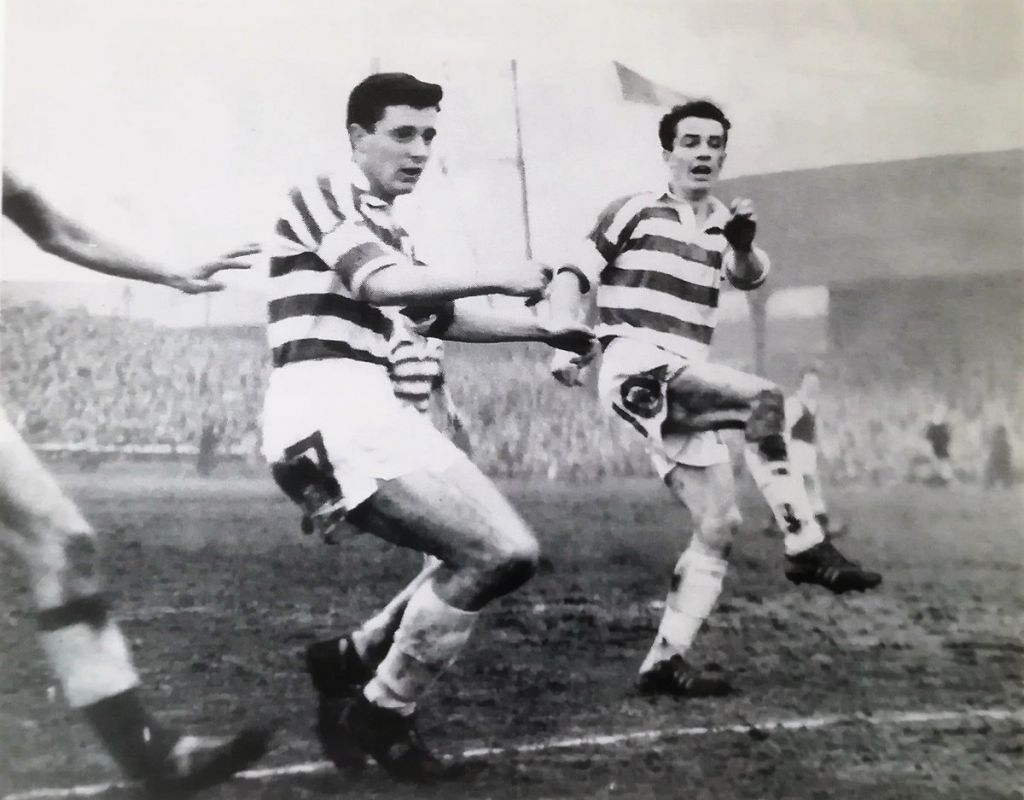
Charlie Gallagher? What a Player!
Celtic meantime had a less than totally successful season. Out of Europe before Christmas, they lost the League Cup final to Hibs and the Scottish Cup final to Rangers, in both cases rather unluckily. But they did hold on
to their League title for the 8th year in a row, after a prolonged struggle in which, at several points it appeared that Rangers would prevail. But Celtic held firm, and won the League in an epic game at Easter Road against the strong going Hibs. Generally speaking, it had not been a great season for Scottish football with major problems of hooliganism and falling attendances. Scotland lost to England for the third year in a row at Wembley, but a revival was forthcoming in that quarter.
Charlie Gallagher, his career now at an end, would now have loads of leisure to watch Celtic, except for the fact that he had three young children. More pertinently however, he would have to find himself a job – always a problem for a footballer at the end of his career.
David Potter
To be continued…