The Celtic Wiki suggests that Jack Connor was the second-highest goalscorer in the Scottish top-flight that season, and whilst I am struggling to get definitive numbers to confirm this, his tally of 47 League goals in 70 games across two seasons at Broomfield would make that prospect a distinct possibility. Jack’s goalscoring achievements become even more impressive when you consider that Airdrieonians were actually relegated at the end of that 1935/36 campaign. That two-year period would include a short spell on loan at neighbouring Albion Rovers in 1934, where he scored eight goals in six games.
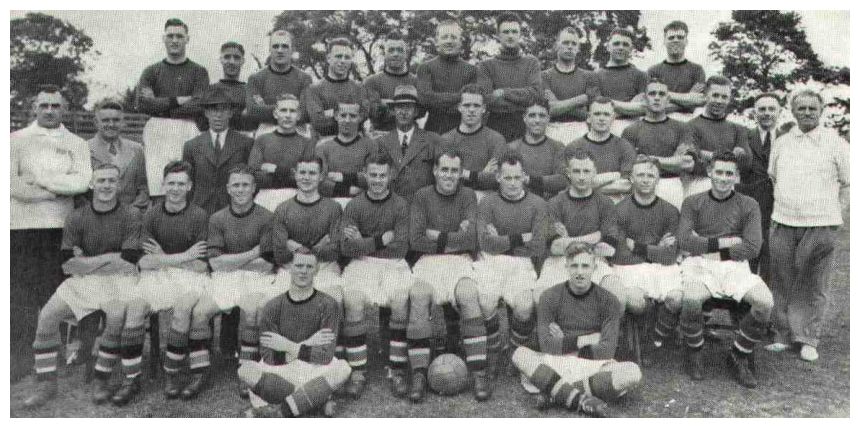
Plymouth Argyle 1937-38
Such prolific form would not go unnoticed. On Saturday, 26 September 1936, having just turned 25, Jack made his debut for English Second Division side, Plymouth Argyle in a home League fixture with Nottingham Forest, scoring twice in a 4-1 win. He would enjoy a successful introduction at Home Park, scoring again a fortnight later as the Pilgrims drew 2-2 with Aston Villa in front of over 43,000 fans in south Devon. Further goals would follow against Norwich City, the now-defunct Bradford Park Avenue, and Sheffield United, before he notched Argyle’s third in a 3-1 victory at White Hart Lane on Saturday, 28 November 1936. Jack continued to find the net with goals against Bury at Home Park then away to Doncaster Rovers, either side of Christmas, as two familiar faces joined him in Plymouth, former Celtic colleagues Tom Ryan and Jim Foley.
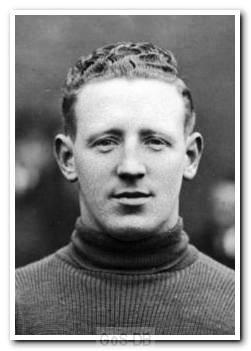
Jim Foley
Irish keeper Foley was the victim of a horrible miscarriage of Scottish justice, following an incident at Tynecastle during a Scottish Alliance match the previous November, which prompted his exit from Parkhead, an episode covered in an earlier part of this series. In summary, despite being headbutted by a pitch-invading spectator, Jim was subsequently charged with assault, tried and convicted in an Edinburgh court, then forced to pay a fine or serve a custodial sentence. Foley would make his Argyle debut alongside Jack Connor in the 1-0 victory over Coventry City on Saturday, 9 January 1937.
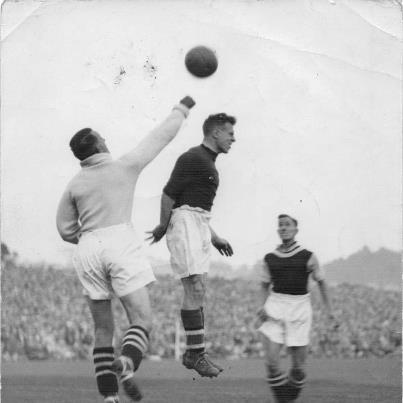
Jack Connor playing for Plymouth Argyle
Jack grabbed both Plymouth goals in the 3-2 defeat at Filbert St, Leicester, two weeks later but failed to find the net as Spurs took revenge for that earlier clash by knocking the Pilgrims out of the FA Cup in north London the following weekend. After missing the next two games, Jack was back with a bang, scoring a double at Villa Park as his side lost by the odd goal in nine, on Saturday, 13 February 1937 then the second as Argyle beat West Ham United 2-0 seven days later. The month ended with another win on the road, Jack hitting the opener as the Devon club beat Norwich City 2-1 at Carrow Road.
The game in East Anglia on Saturday, 27 February 1937 would mark the Plymouth debut of wing-half Tommy Ryan. He had joined Celtic from junior outfit St Anthony’s in 1933 and would feature with Jim Foley and a number of the other ‘periphery’ Celts on the autograph sheet which is the original source of this article, such as John Boyle, Danny Dawson and Willie Hughes.
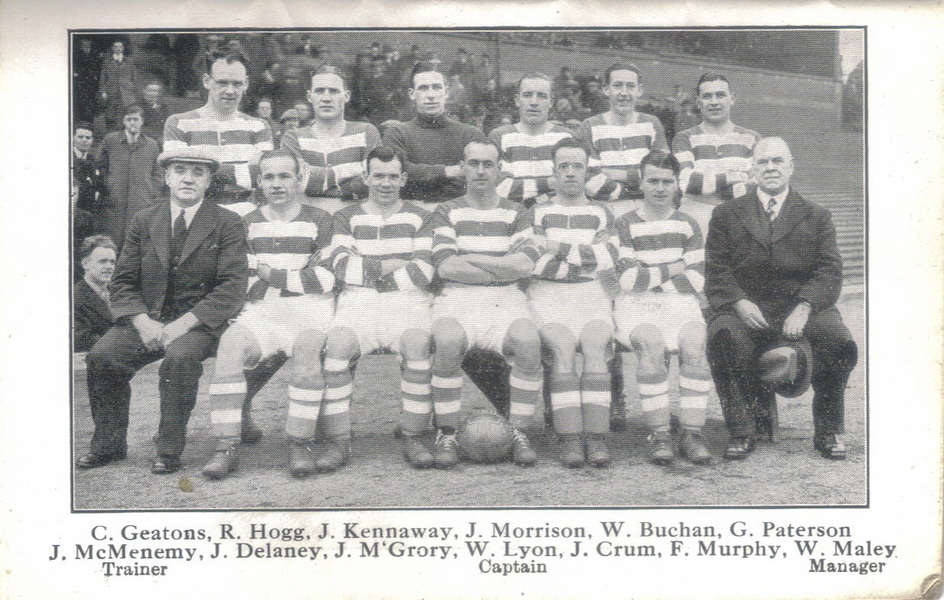
Tommy would struggle to displace regular wing-halves Chic Geatons or George Paterson, with Hughes and Dawson ahead of him in the queue should either be missing. He would not feature in the first team at Parkhead and moved to Plymouth at Christmas 1936, just a few days before Foley followed. Sadly, Ryan would find the same situation at Argyle, where the long-serving duo Archie Gorman and Tommy Black were automatic picks. He would make just seven starts at Plymouth, before joining Swindon Town in the summer of 1939.
March 1937 opened with a 1-1 draw at home to Newcastle United, Connor once again on target, albeit it would be his only goal that month, as the Pilgrims suffered a blip in what had been an impressive season to date, with three draws and two defeats from their six matches. They would get back on track in mid-April, after another couple of draws, Jack hitting the second in a 2-0 win over Blackburn Rovers at Home Park. The campaign would end on a bit of a low, with defeats by the Lancashire duo of Bury and Burnley, and Connor missing the final game at home to the Clarets. Nevertheless, it had been a fine start to his career down south, with 17 goals from just 34 starts, a goal every two games, enough for him to top the goalscoring charts at the club in his first season there.
Plymouth Argyle finished in fifth place in the second tier of English football in 1936/37, their highest-ever placing until that point. Indeed, only once since then have they improved on that, reaching fourth in 1952/53. They would finish level on points with both Newcastle United and West Ham United, splitting the pair on goal average, and behind Bury, promoted Blackpool and champions Leicester City, whilst Bradford City and Doncaster Rovers would drop into the Third Division (North), as it was back then. Argyle would be joined in the Second Division the following season by relegated Manchester United and Sheffield Wednesday, whilst the Old Trafford faithful’s misery would be complete by the sight of fierce rivals City claiming their first English title on the other side of Manchester.
The FA Cup was won by a Sunderland side featuring most of the players who would become English champions the following season before being beaten by Celtic in the first tie of the Empire Exhibition Cup at Ibrox. They defeated a Preston North End side at Wembley which included Bill Shankly and three former Celtic teammates of Jack Connor, Willie Fagan and the O’Donnell brothers. Frank O’Donnell had opened the scoring just before the break before three second-half goals took the trophy to Wearside.
Jack’s second season on England’s south-west coast would not go quite so well. He would miss the opening three games of the campaign before appearing against Blackburn Rovers at Home Park on Wednesday, 8 September, true to form Connor scoring Argyle’s first goal in a 2-2 draw. And he would grab the second for Plymouth as four goals were shared with Swansea Town at the same venue ten days later. This would prove to be his final goal for the club, Jack losing his place up front after successive defeats by Norwich City, Aston Villa and Bradford Park Avenue saw the Pilgrims still seeking a first League win since the opening day of the campaign. They would finally get that elusive second victory at the thirteenth time of asking, beating Sheffield United on Saturday, 30 October 1937.
Jack would still be missing as Argyle visited Old Trafford in early November, the match ending goalless, and competition would soon arrive in the shape of Everton centre-forward, Bill Hullett. The youngster would grab his chance with 20 goals in 29 games before signing for Manchester United one year later. Connor would not feature again until the return fixture with Norwich City, on Saturday, 5 February 1938, which ended 1-1. This would be the final appearance for Plymouth for Jim Foley. He had been convicted in Edinburgh four days previously, and decided to return to his native Cork, where he would later enjoy league and cup success in the FAI Cup with Cork United. Jim died in October 1952, just 38.
Argyle’s Scottish manager Bob Jack would retire from the club in April 1938, after 28 years and more than 1,000 games in charge at Home Park. His son, David, had also played briefly under him at Argyle, but is better known as the man involved in the first £10,000 transfer, when he moved from Bolton Wanderers to Arsenal in 1928. Five years earlier, David had become the first player to score at Wembley, netting Bolton’s opener in their 2-0 victory over West Ham United in the famous ‘white horse’ FA Cup final. Bob would carry out some scouting work post-retirement for his famous son, now the manager at his father’s local club, Southend United. He would pass away five years later, aged 67.
Jack Connor would soon follow Jim Foley and his manager Bob Jack out of Home Park. He had retained his place after the draw with Norwich for the 1-0 victory over Bradford Park Avenue then the midweek visit to Villa Park, where Plymouth lost 3-0, however, that night in Birmingham would turn out to be Connor’s last game for the club. After 44 games and 19 goals, he would leave Devon for Wales, joining Swansea Town, against whom he had scored his last goal, after a rather disappointing second season.
Jack would spend just one season at the Vetch Field, scoring one League goal in twelve appearances, before heading back north at the outbreak of war to join Queen of the South. With the Scottish League abandoned in early September after just five matches, the new Western Regional League would see Connor make a return trip to his first love on Saturday, 4 November 1939, scoring twice as his Dumfries side beat Celtic 3-0, consigning the Hoops to the bottom of the table, pointless after three games. He would enjoy a tremendous first season there, as the Doonhammers chased Rangers all the way before, ironically, a 3-1 home defeat by Celtic in April swung the Regional title towards Govan. Celtic’s stance against fielding guest players would be a factor in their final position of thirteenth from sixteen teams.
Having done so well in 1939/40, strangely Queen of the South did not feature again for six seasons in the Regional League, thus it is unclear if or where Jack played competitive football during this period. He would finish his career after the war with short spells at second-tier Alloa Athletic and St Johnstone, before return to his junior side, St Roch’s, as manager, in 1948. Thus Jack’s career circle was complete.
Jack remained friendly with Jimmy McGrory until the great man died in October 1982, his grandson Joe advising me that he was one of the last visitors to Jimmy’s bedside. Connor himself passed away some twelve years later, in June 1994, aged 82. He is back in God’s garden again.
Whilst I have known his grandson Joe, a wonderful Celtic man, for thirty years or so, Jack’s legacy now lives on in the next generation, through his great-grandson Ciaran. He is one of those dedicated fans who travel all over the world to support the team. I have had the pleasure of meeting him on one or two of those trips recently, and he was also present in the Brazen Head at the last @Italian Celts function I attended, belting out ‘Bella Ciao’ with the best of them. In the photos of Jack in his Plymouth days in particular, the resemblance between him and young Ciaran is uncanny.
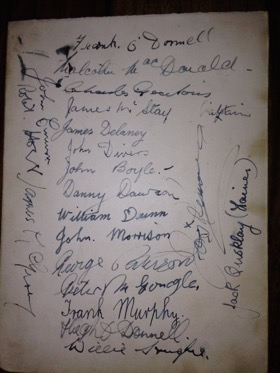
The story of Jack Connor before, during and after his Celtic career brings to an end our review of the twenty names on the autograph list. Just one question remains. Why did it end up in Kingussie, and the Star Hotel in the village, specifically?
There have been various options suggested, perhaps the most obvious one being that the Celtic team had stayed there at one point, en route or returning from an away game, although in the early parts of the story I had struggled to find such a match where the names had aligned with those involved.
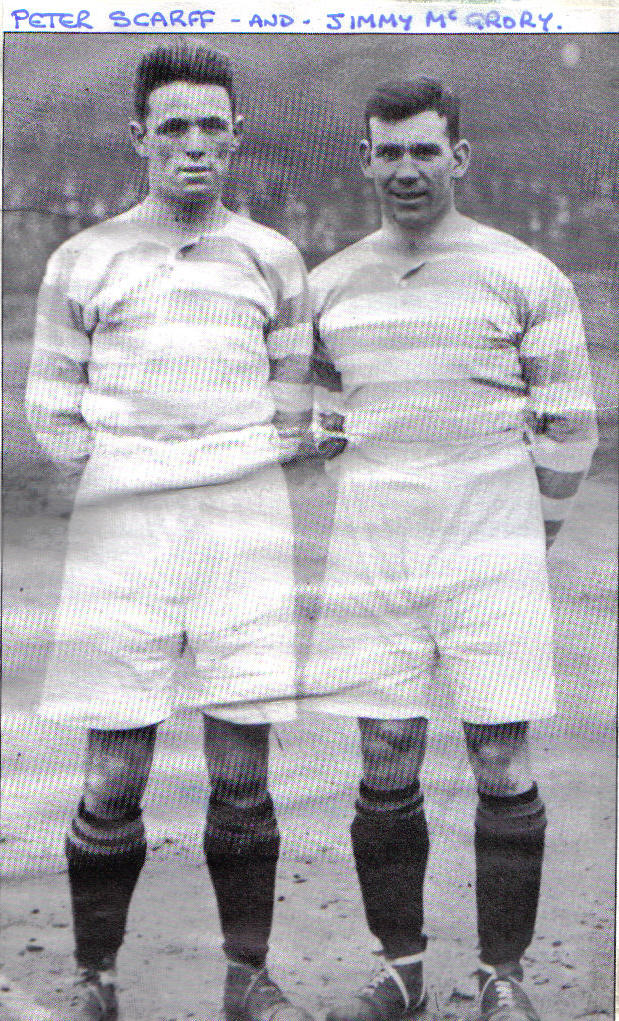
Perhaps the answer lies in a name which was not on the list, and for good reason, that of Peter Scarff. Much-loved inside forward Peter had taken ill in the aftermath of the death of John Thomson, struggling on for a few weeks before playing what would turn out to be his final match for the club in the 6-0 victory over Leith Athletic at Celtic Park on Saturday, 19 December 1931. There are reports of him coughing up blood afterwards, following which he was diagnosed as suffering from pulmonary tuberculosis. He would be hospitalised and would never recover from the illness, passing away almost exactly two years later at his home in Linwood, on Saturday, 9 December 1933. He was only 25.
This would not be a new experience for Celtic manager, Willie Maley, who had placed a Hoops top on Peter’s coffin. The best part of forty years earlier, he had watched as another Peter, left-half Dowds, had died from the same illness in nearby Johnstone, on 2 September 1895. He had been a teammate of Maley’s as the Scottish League commenced in August 1890 and had appeared in Celtic’s first Scottish Cup win in April 1892. Dowds then moved to England and enjoyed spells at Aston Villa and Stoke City before returning to Parkhead two years later. He would play only three more times for the club before contracting tuberculosis, passing away twelve months later, the first Celt to do so whilst still a player. He was one year younger than Peter Scarff, aged just 24 at the time of his death.
In the intervening years, Maley would see a number of his colleagues or players cut down before their prime, some of whom we have already covered in this article, Sunny Jim Young at 40 in a motor-cycle accident, Peter Johnstone in war-torn France and John Thomson in the act of protecting his goal. Each one would have hit the man who gave his own life to Celtic in a different way, just that little bit harder.
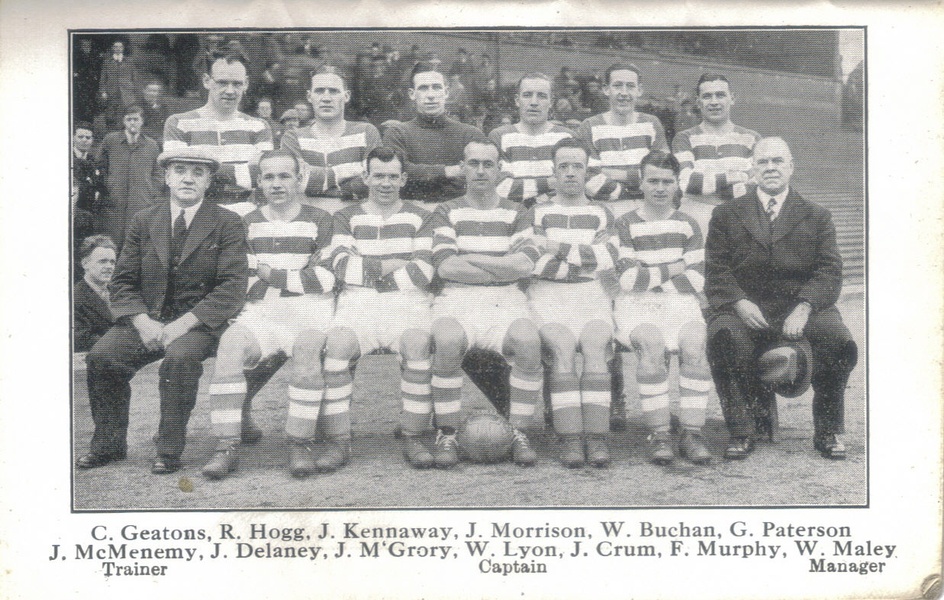
Treatment of chronic illnesses such as tuberculosis back then would normally have involved a stay in the horribly-named medical facilities of the time, known as sanitoriums. Both Peters were certainly treated in such establishments. Fast-forwarding two decades from Peter Scarff’s death, to the evening of Monday, 10 August 1953, we find Willie Maley returning to Celtic Park after an absence of over thirteen years, a legacy of the acrimonious manner of his departure from Parkhead in February 1940.
The now 85-year-old Maley was there to attend a testimonial match arranged in his honour between the recently-crowned Coronation Cup-winners and a Bohemians select. The historic event produced a memorable photograph where the past, present and future Celtic managers are captured together, as Maley is flanked by McGrory and captain Jock Stein as the sides pose in front of the main stand. The beneficiary of Willie Maley’s 1953 testimonial fund was a cause close to his heart and of which he had been a patron for many years…the Grampian Sanatorium in Kingussie.
So does the solution to the mystery of the Celtic autographs perhaps lie not on the pitch but in the legendary Celtic manager’s visits to the small Highland village to patronise or support a local hospital?
I guess we’ll never know for sure.
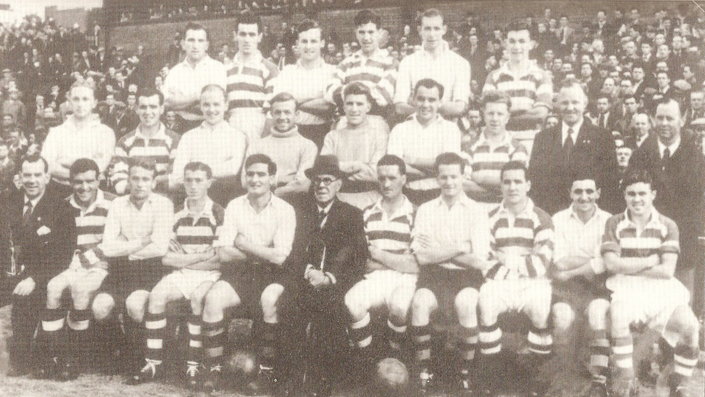
Willie Maley passed away five years later, on 2 April 1958, just a few weeks short of his 90th birthday, the last link to the origins of Celtic, having played with or managed all of the greats over half-a-century.
Thanks, as always, to the Celtic Wiki, a wonderful source of reference information.
Hail Hail!
Matt Corr