
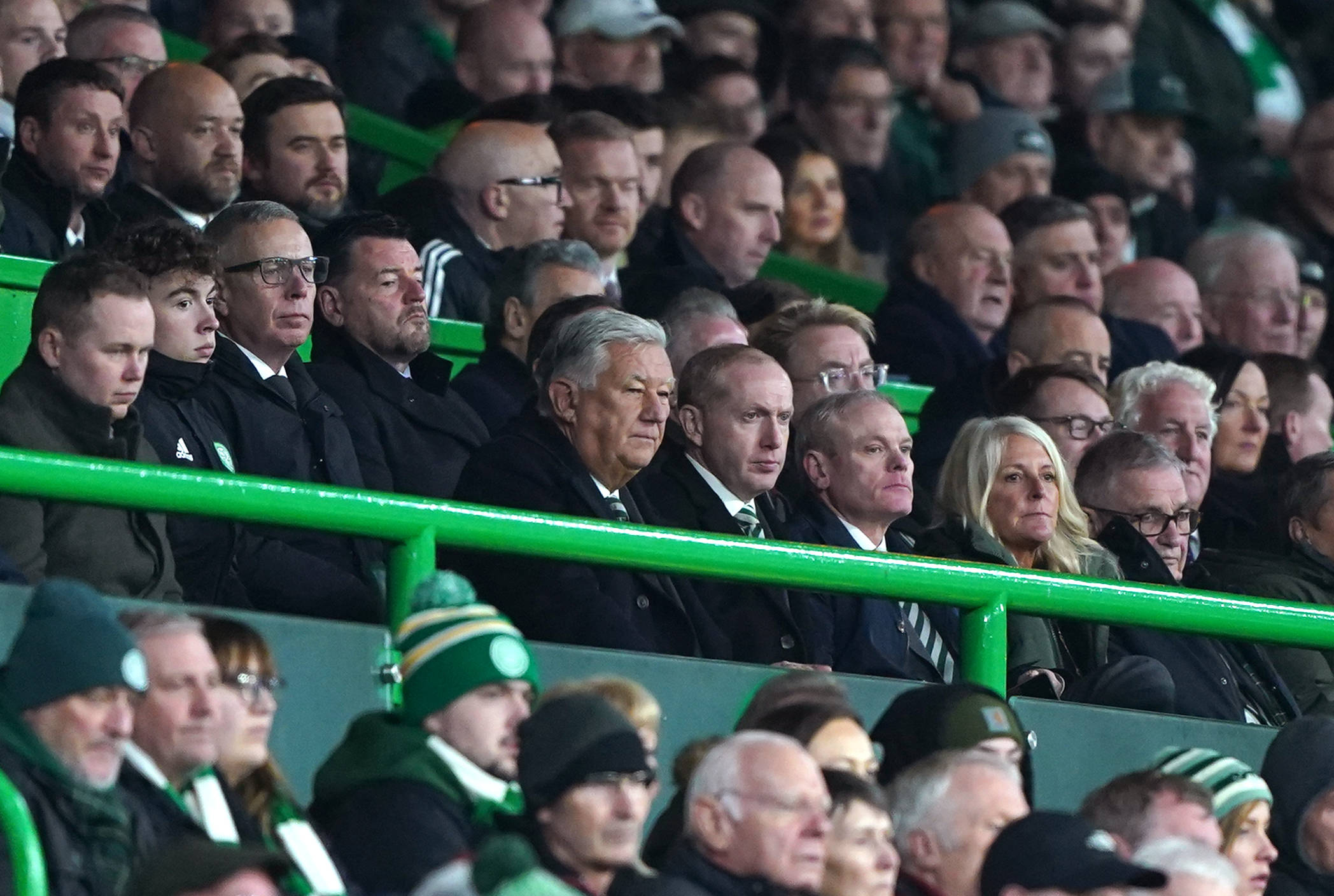
On Saturday evening, Celtic released a lengthy statement in response to growing unrest among supporters. It was meant to explain the club’s transfer policy and reassure fans of the board’s commitment to success. Instead, it landed with a thud…
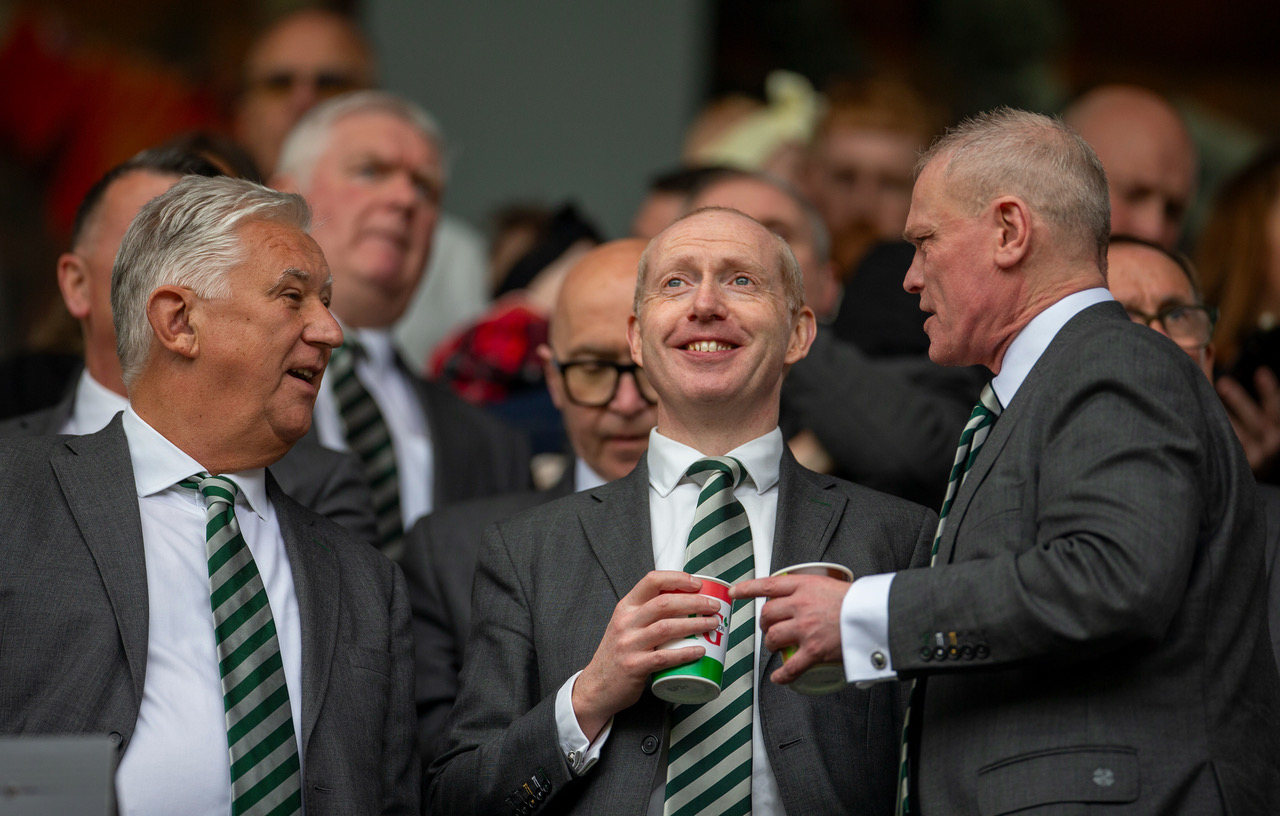
The Celtic Board. Celtic Champions 2025. Dundee United v Celtic, 26 April 2025. Photo Vagelis Georgariou (The Celtic Star).
What should have been a straightforward message of – ‘we hear you, we got it wrong, here’s how we’ll improve, and here’s how we’ll be held to account in our endeavours’— turned into a rambling, jargon-heavy suicide note. It read less like communication with supporters and more like a defensive internal memo, designed to cover backsides at board level rather than confront hard truths.
Frustration, anger, and ridicule
The reaction from the wider support was as predictable as the content in the statement. Frustration, anger, and ridicule. What was intended to calm the storm may instead have lit a fire that proves impossible to extinguish.
The statement opened by referencing ‘constructive meetings’ with several supporter groups. The intent there was obvious – to claim legitimacy by grounding the board’s words in fan consultation. Yet the effect was the opposite.
By highlighting these meetings, the board exposed its tactic—divide and conquer. We warned as much on this site yesterday – Celtic board now gaslighting the Celtic support.
Celtic Football Club Statement.
— Celtic Football Club (@CelticFC) September 6, 2025
The fan organisations involved have now seen how they were used. Invited in for polite conversation, they may well be considering the invite was forwarded only so their names could be attached to what could be construed as a pre-written narrative. This is not consultation. It is manipulation. The wider support recognises that too, and going forward the challenge will be to present a united front.
By their own definition, they are failing
The board reiterated that Celtic’s objective is to compete in the Champions League. But by their own definition, they are failing. Five times in succession, Celtic have fallen at the qualification stage. A club with genuine ambition for the Champions League would invest in the squad early, aggressively, and smartly to give itself the best chance. Instead, year after year, the same mistakes repeat.
The consequence is more than just the embarrassment we all felt exiting to Kairat, it’s also financial. Missing out on the group stages means losing tens of millions in revenue. Ironically, the very caution the board believes keeps the club safe is what undermines its financial health.
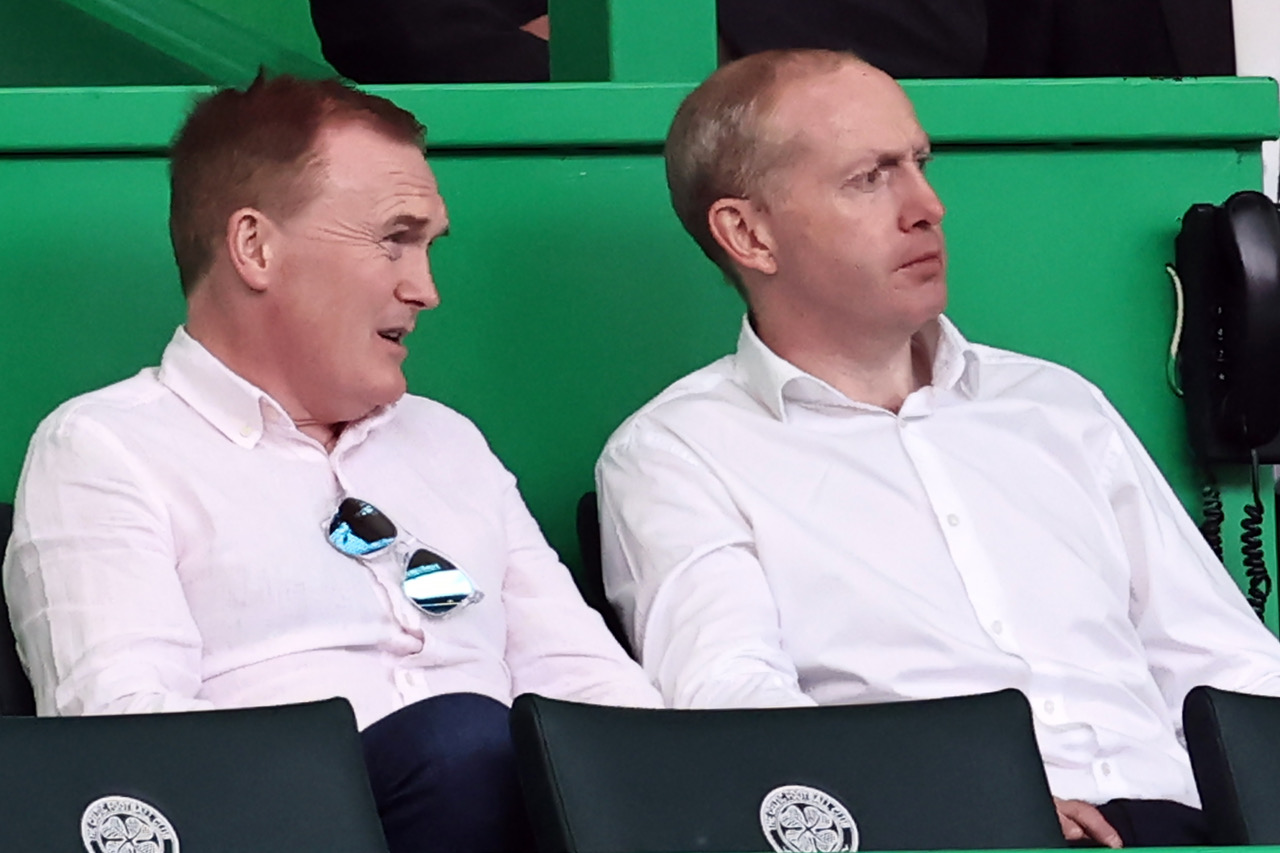
Michael Nicholson at Celtic Park. Sunday 18 May 2025. Celtic v FC Women v Motherwell. Photo AJ (The Celtic Star)
Much of the statement was built on a single phrase – the ‘self-sustaining model.’ According to the board, this model is non-negotiable and essential under UEFA regulations. That could be considered something of a distortion.
This is not restraint, it is underinvestment
UEFA’s rules – the Financial Sustainability Regulations – cap spending on wages, transfers, and agent fees at 70% of revenues. Celtic’s 2024 revenues were £124m. Wage costs were £66m. Celtic spent just £14m. Here’s Swiss Ramble’s calculations –
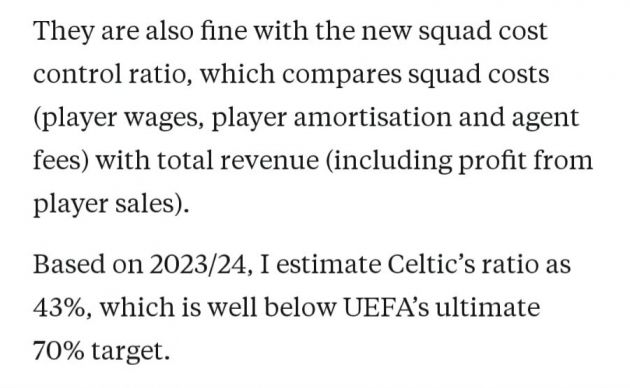
This is not restraint, it is underinvestment. Cash reserves are dismissed as ‘irrelevant’ in the statement, but that is misleading. While reserves don’t count in UEFA’s break-even calculations, their existence shows financial strength and provides the security to spend at least close to the 70% limit.
In fact, Celtic’s reserves – a revised figure will be published very soon but £100m is a fair estimate – pose their own problem. Money sitting idle in the bank erodes through inflation and risks triggering higher tax bills. Worse, every pound not spent on the team or club infrastructure is a pound not working to deliver the success supporters demand. If there are reasons for hoarding this money, the board once again chose not to communicate those reasons.
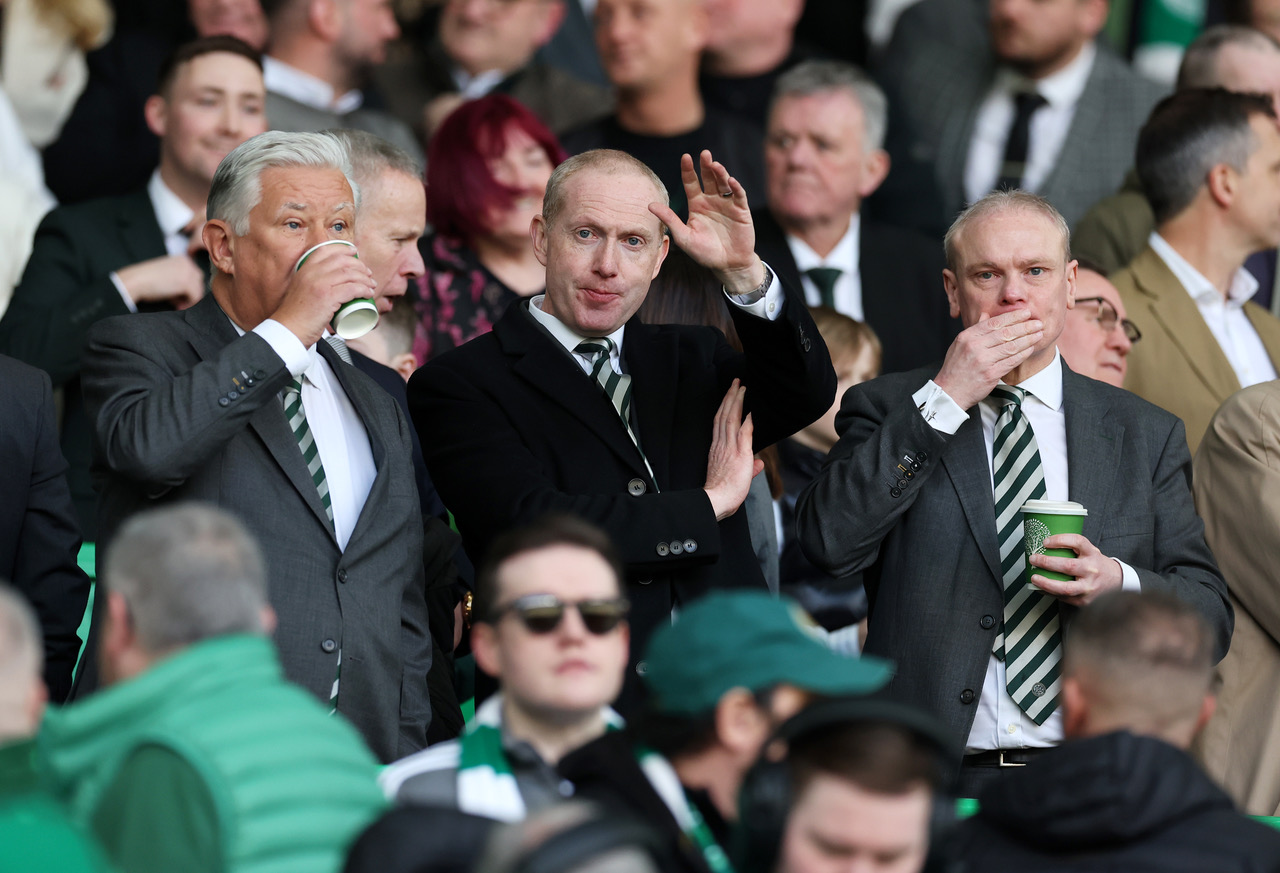
Peter Lawwell, Michael Nicholson and Chris McKay watch on during the Scottish Gas Scottish Cup Quarter-Final match between Celtic and Hibernian at Celtic Park on March 09, 2025. (Photo by Ian MacNicol/Getty Images)
It is a straw man argument
One phrase in the statement jumped out immediately: ‘throwing money at transfers is not a sustainable route to success.’
It is a straw man argument. Nobody is asking Celtic to become reckless or to mortgage the future. What supporters demand is realistic, intelligent spending that reflects the modern market and the club’s healthy finances.
The real hypocrisy lies in how the board treats the market. When selling players, Celtic are more than happy to embrace ‘inflated’ prices—£25m for Jota, £25m for Tierney, £25m for O’Riley and £17m for Kuhn. But when buying, the same market is suddenly dismissed as irrational. Other clubs, apparently, should not expect the same premiums Celtic demand.
The board cannot have it both ways.
The statement insisted that Celtic’s ‘clear goal’ is to secure signings early in each transfer window so they can integrate before the season begins. The reality is, as we are aware, very different.
This is a pattern, not a coincidence
Season after season, crucial signings arrive late—after Champions League qualifiers have already been lost. This year Balikwisha and Tounetki arrived too late to make any impact in Europe. Last year, the Adam Idah deal dragged on, as did Bernardo’s. This is a pattern, not a coincidence.
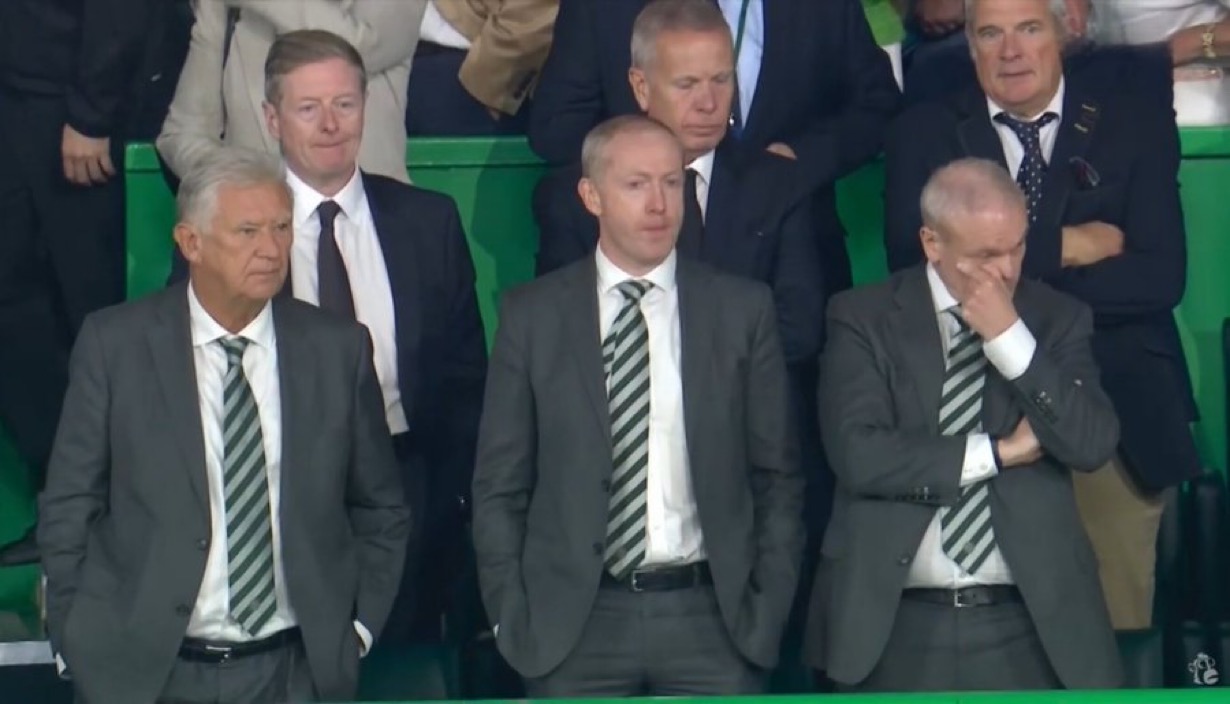
Peter Lawwell, Michael Nicholson and Christopher McKay watch on as Celtic draw 0-0 with Kairat at Celtic Park in the UEFA Champions League play-off match, worth over £40m to the winners.
The excuse that ‘selling clubs wait until the last day’ is laughable. No well-run recruitment department leaves itself scrabbling at the end of the window. We saw why only days ago. If one deal falls through, you move to the next, with, crucially, time to pivot. If one player demands too much, you have a list of alternatives. Celtic’s recruitment repeatedly shows neither decisiveness nor contingency planning.
The result is a weaker squad now than two years ago. Key players have gone without adequate replacements. Progression has stalled; indeed, regression is probably a more accurate description.
Another striking feature of the statement is what was missing – a name. Not the chairman, not the chief executive. Nobody put their signature to it. Remarkable really.
This is emblematic of the problem. Leadership requires accountability, perhaps the one thing this board is more fearful of than scrutiny. If you make decisions, you stand behind them. Hiding behind anonymous, corporate prose is the opposite of leadership. It tells supporters everything they need to know about the culture of the boardroom as what we worry it to be – distant, defensive – fearful even.
We are told reserves are used for the ‘continuous improvement’ of the club. Supporters are entitled to ask – where is the evidence to support that claim?
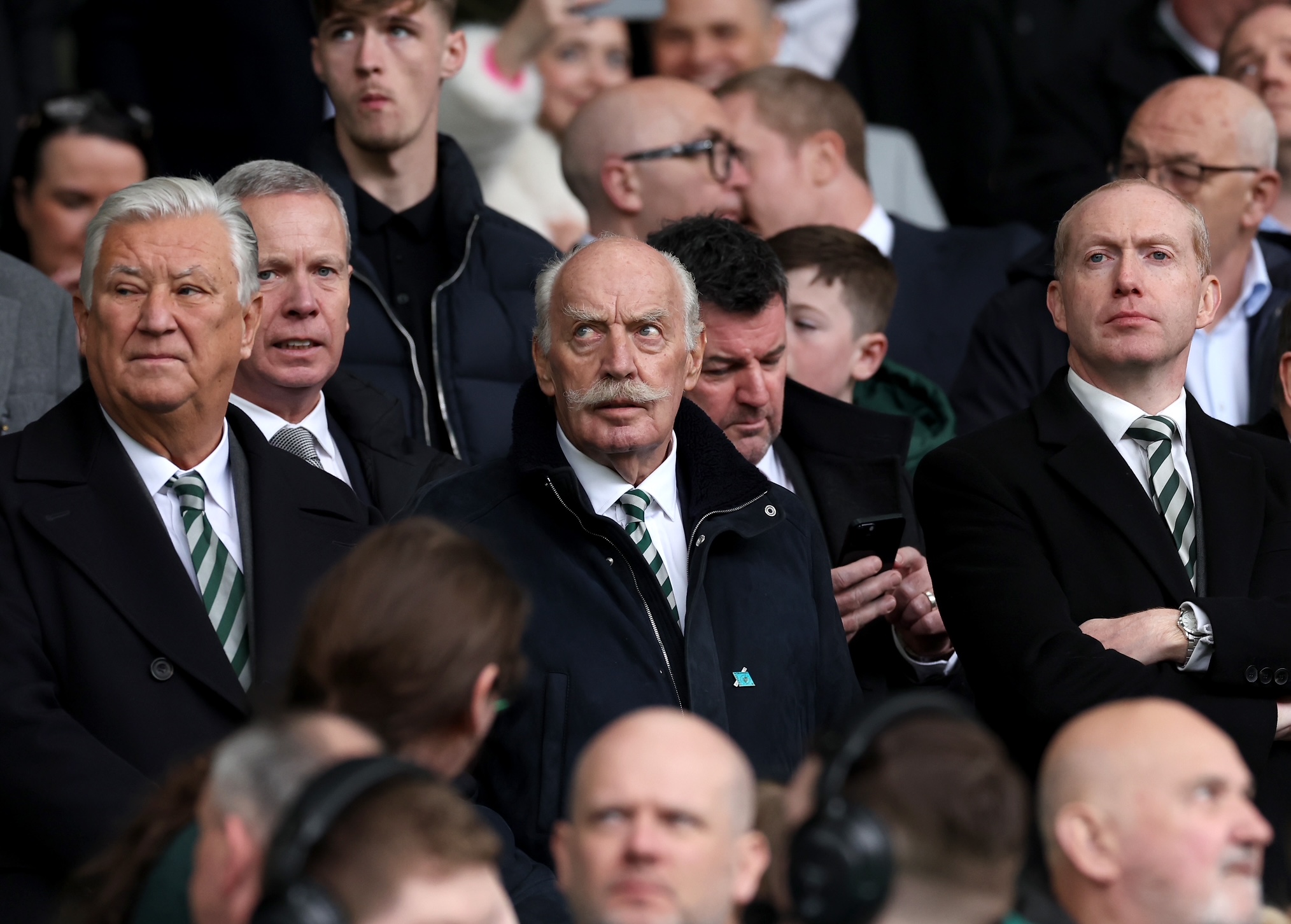
Peter Lawwell, Chairman of Celtic, Dermot Desmond, Non-Executive Director of Celtic, and Michael Nicholson, CEO of Celtic, are seen in attendance prior to the Scottish Premiership match between Celtic and theRangers at Celtic Park on March 16, 2025. (Photo by Ian MacNicol/Getty Images)
The stadium is tired, the main stand embarrassingly outdated. Facilities lag behind other European clubs. Even basics—warm water in toilets—go unattended.
The youth academy, supposedly a cornerstone of the model, is failing. Scotland’s recent youth squads featured barely a Celtic player. This is not the pipeline of Champions League talent we are promised. Kieran Tierney made his competitive debut for Celtic in April 2015. We have yet to produce another first team regular from our own Academy.
What has improved? Certainly not the squad. Not the matchday experience. Not the academy. Directors’ remuneration, however, has risen, so there’s that.
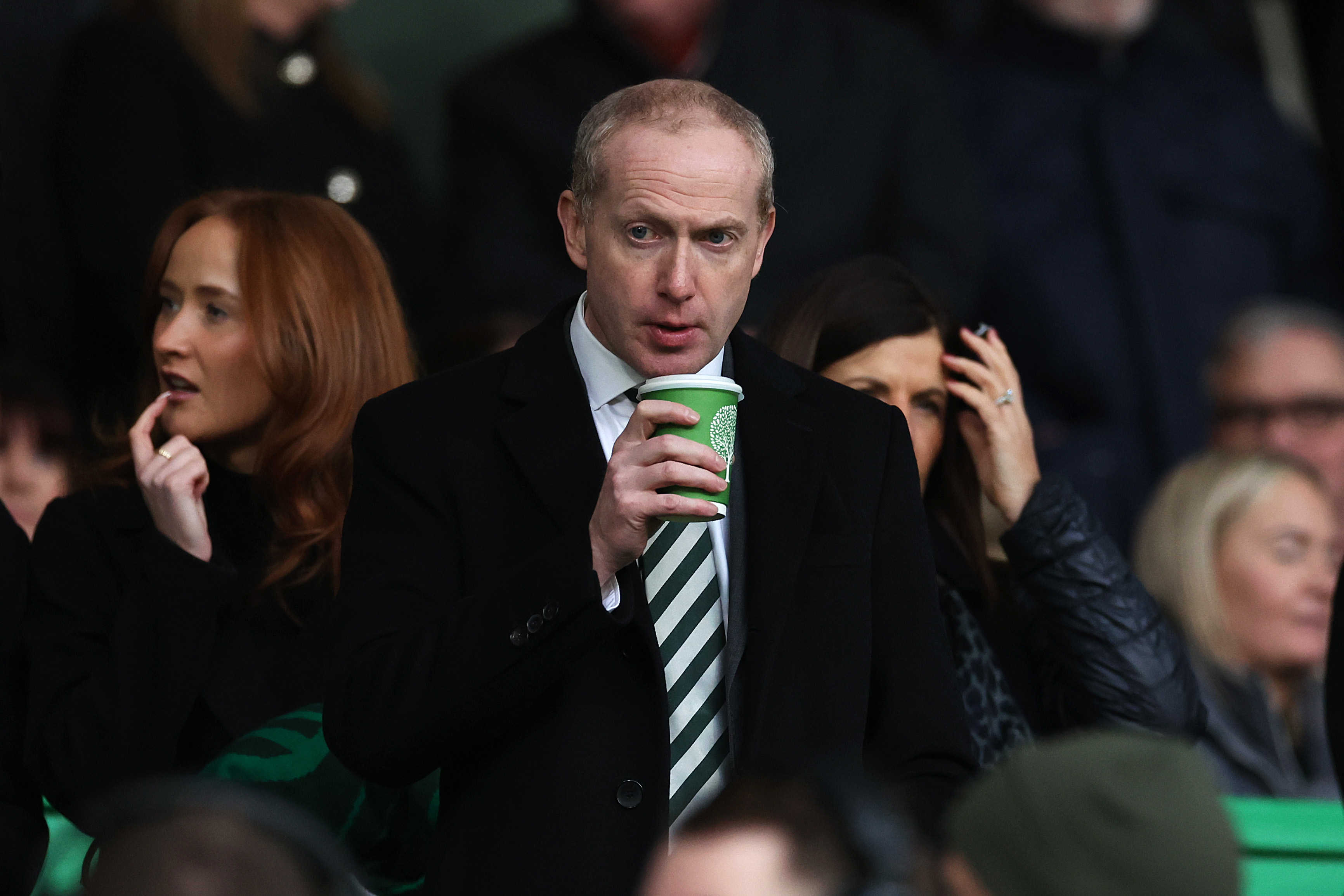
Michael Nicholson, Chief Executive Officer of Celtic, looks on from the stands ahead of the Premiership match between Celtic and St. Johnstone at Celtic Park on December 29, 2024. (Photo by Ian MacNicol/Getty Images)
On every measure, the board is failing
The most damning aspect of the statement is that the board helpfully listed its own strategic objectives. Compete in the Champions League. Strengthen the squad. Create Champions League-level players. Progress academy talent. On every measure, the board is failing.
Not one of these targets is being met. To issue a statement trumpeting these goals while falling short on each one is staggering arrogance.
The tone of the statement was also pretty revealing. Sneering references to ‘social media.’ Warnings about ‘speculation.’ Patronising lectures on financial prudence. It read like something from the 1990s, drafted by people who still believe supporters are grateful customers who should simply buy tickets and replica shirts, and ideally remain as mute as our CEO.
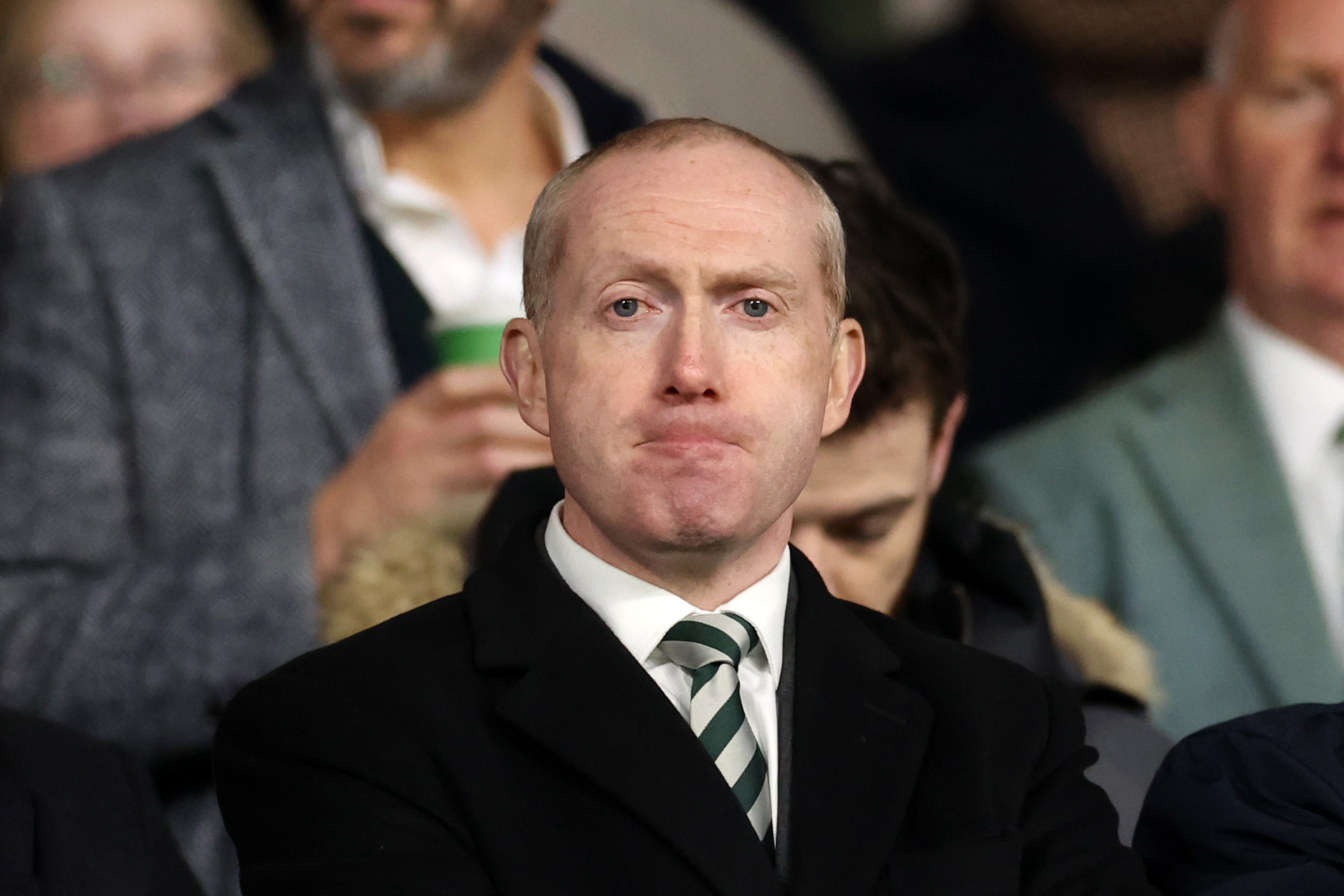
Michael Nicholson, Chief Executive Officer (CEO) of Celtic, looks on prior to the UEFA Champions League match between Celtic FC and Club Brugge KV at Celtic Park on November 27, 2024 . (Photo by Ian MacNicol/Getty Images)
Supporters know when they are being gaslit
But football has moved on. Supporters are informed, connected, and capable of dissecting financial reports and UEFA regulations. Supporters know when they are being gaslit.
Other clubs have publicly mocked Celtic’s approach this summer, laughing at derisory bids. Even within the dressing room, the captain and the manager have hinted at frustration. The disconnect between boardroom and football department is already a concern for many of us.
It is worth asking then who was this statement really written for? The fans? Or the investors?
When football becomes secondary to finance, the very essence of the club is in danger of becoming lost.
The language, the length, the defensive tone—it reads less like a message to supporters and more like a reassurance exercise for the PLC’s shareholders. ‘Don’t worry, the model is intact, the cash pile is safe, the balance sheet is strong.’ The problem is that Celtic is not just a balance sheet. It is a football club. When football becomes secondary to finance, the very essence of the club is in danger of becoming lost.
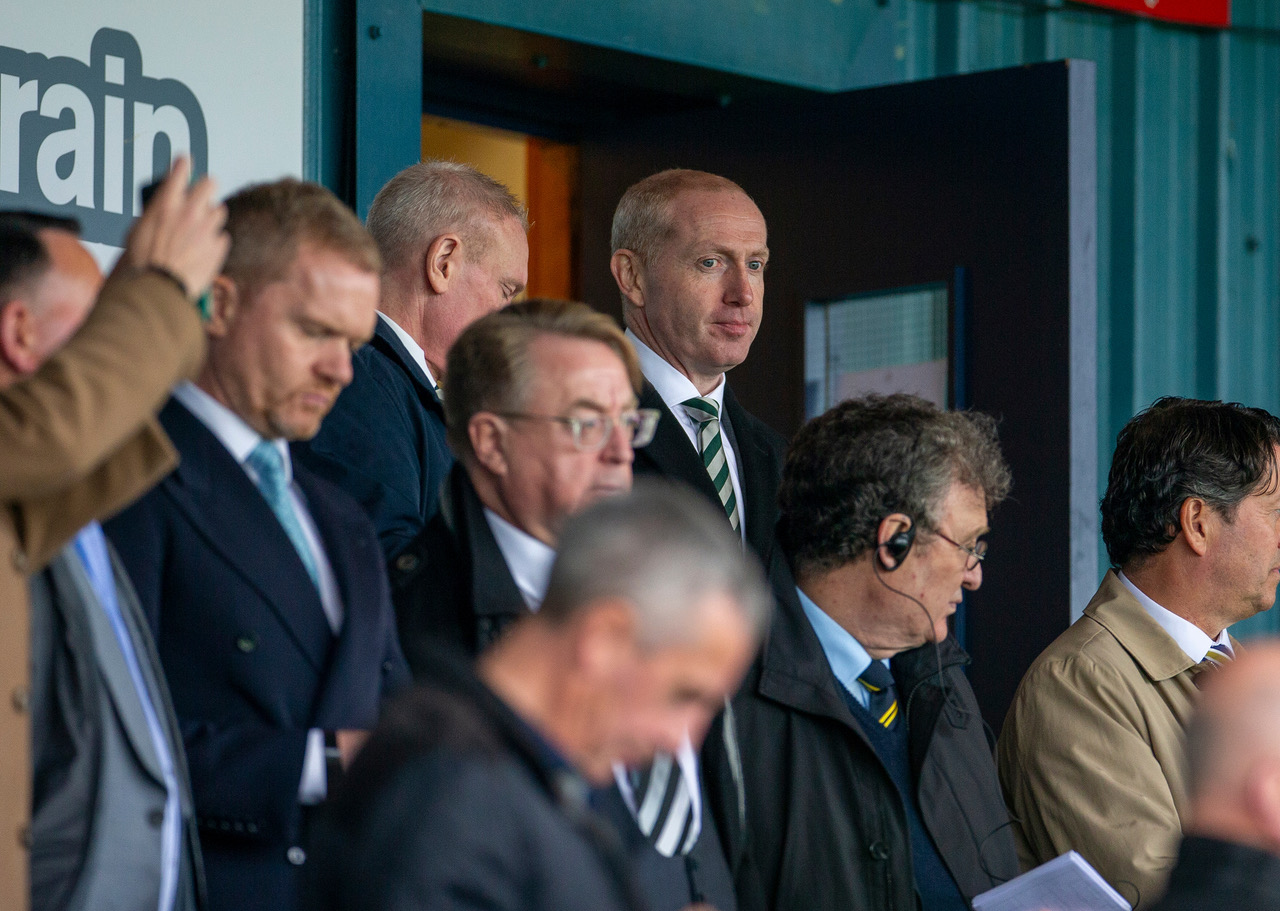
Celtic CEO Michael Nicholson at Dingwall on Sunday . Photo Vagelis Georgariou
If the statement revealed anything, it is that the board sees UEFA regulations and the ‘self-sustaining model’ as their shield. They believe as long as they remain in profit, the support, or perhaps more accurately, the shareholders, can be placated.
The obvious pressure point, which they have kindly outlined themselves, then, is annual revenue. If supporters want change, the way to force it is not just protests but arguably targeted boycotts—merchandise, hospitality, and add-on ticket sales. We already know some fans have removed themselves from the Home Cup Ticket Scheme. Supporters will make their own choices in that regard. Shareholders will care about falling revenue even if they don’t care about falling standards on the pitch. As such the board’s arrogance may yet be its undoing.
Celtic’s statement could well go down as one of the great misjudgements in modern Scottish football. Intended as reassurance, it has been received as confirmation that this board is out of touch, out of ideas, and running out of time.
By their own metrics, they are failing. By their own words, they have shown contempt. By their own tone, they have insulted the intelligence of their supporters, or should that be customers?
Niall J

Celtic v Kilmarnock – Celtic chairman Peter Lawwell and CEO Michael Nicholson during the cinch Premiership match at Celtic Park on Saturday February 17, 2024. Photo Andrew Milligan
Celtic in the Eighties – Out Now!…
Celtic in the Eighties by the late, great David Potter is out now on Celtic Star Books. Celtic in the Eighties is now available in the Celtic superstore and all other club shops. And don’t forget that you can still purchase your copy directly from Celticstarbooks.com for same day postage.
Order Celtic in the Eighties today, you’ll be glad you did, it’s a fabulous read!

OUT NOW! Celtic in the Eighties by David Potter. Foreword by Danny McGrain. Published on Celtic Star Books. Click on image to order.





Interesting and thank you..
The Board has clearly messed up this time and not only missed players but missed a considerable amount of money in not qualifying for the Champions League.
Saying that, we do not know what players were asking in wages, etc and it is right that an inflated price should not be paid for a player. It is also right that the Board has done exceptionally well in the recent past, ensuring the financial wealth of the club and supporters rightly congratulated them on this.
An open and honest apology would have been accepted, though bitterly complained about and rightly so.
Much has also been said about the skill of Brendan Rodgers. However, his team was a pathetic example of what our team should be in the games against Kairat. A dreadful display in both legs. His politicking should have gone on behind closed doors and not in public, where the players must surely have been affected by it as well as supporters.
Someone at the club, presumably Brendan, made a huge mistake in letting Oh go for nothing. OK, his transfer from his new club to Germany fell through, but £28 million, or was it £24 million, was agreed upon to start with. Brendan got Oh completely wrong as he got Idah wrong, costing the team a lot of goals and the club a lot of money.
We can’t keep our best academy players as they rush off to England for the money.
It looks like Brendan is going. His body language is pretty obvious. Bringing back Ange must be on the cards.
The squad now is arguably worse than when Ange took over.
Buying a basket load of players for £1.5M and £2M the way we did twenty years ago is a fools agenda. It means that to compensate for the losses on the many players at that level we sign we must sell one of them for over £15M. Meanwhile the others litter the squad and drain wages.
A quarter of a century ago we signed Lennon, Hartson, and Sutton for roughly £6M apiece but the issue then was we did not have the finances to support them. Now we do, and with Champions League financial carrot, it is inexplicable that we are not doing so.
That our recruitment is so poor now means we have two unhappy players in the squad in Yang and Maeda. One wants to go and the other knows he isn’t wanted.
Here we have a set of reasoned points almost all or maybe all of which I
agree with.
Compare that to the ‘ned’ personal attacks. These are based on pure jealousy of course ‘these guy earn more than me so I hate them.’
Instead here we have arguments that are thought through and must be highlighted in this debate. I wish I had read them before I sent my share holder letter in.
The only way I know that the fans are sticking to their narrative of boycotting can be seen when tickets go on sale for the first europa league game, only then shall we know if the fans are serious or just omitting hot air , I hope it’s the former HH 🤞