80 years ago this week (8 February 1946), the Celtic career of one club legend came to an end…
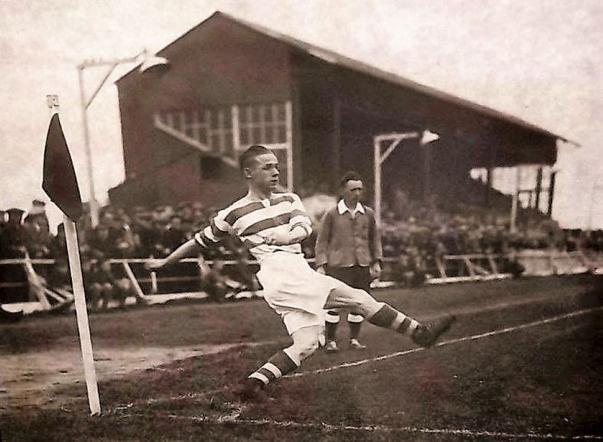
Celtic Star Jimmy Delaney. Photo The Celtic Wiki
Jimmy Delaney was one of the most notable Celts of the 1930s and 1940s, with a reputation that persists even into the modern day. This is his story…
In September 1914 – just weeks after the beginning of World War One – Delaney was born into a family of Irish extraction, living in the Lanarkshire village of Cleland.
Like so many people in this area, he started work as a miner, but his footballing skills would change the direction of his life. He initially played for local side Cleland St Mary’s but in 1933 had trials with Wishaw Juniors and Stoneyburn Juniors, before signing for the latter.
Whilst playing in the Midlothian Junior League, Delaney developed an impressive reputation, which led to a signing race between Celtic and Hibs. In September 1933, the Celts emerged victorious from this, persuading the 19-year-old that his future lay in Glasgow’s east end. It was claimed he was given a £20 signing-on fee, a considerable sum at the time.
Delaney trained with the Celts and played with the reserves in the Alliance League. Then, almost a year after signing, he was ready to make his first team debut. In August 1934, as the Bhoys hosted Hearts in a league game, the new Celt made a positive start as the two teams played out a 0-0 draw.
In fact, Jimmy’s opening experiences in a Celtic shirt were generally goalless. Including the Hearts game, the Celts went four matches without scoring, either drawing 0-0 or losing 1-0 in each match. A 1-1 draw with Rangers ended the scoring drought, but Jimmy was still to personally celebrate when wearing green-and-white.
This changed on 11 September 1934. Celtic had vied with Hibernian for Delaney’s signature and now the Easter Road men came west to Glasgow. They left after a chastening 4-0 defeat, and had particular reason to regret their failure to attract Jimmy to Edinburgh. He got his first goal for the Celts and was off and running.
If Jimmy was seeking inspiration for his time at Celtic Park, he got this the following month. Jimmy McMenemy returned to the club as a coach, and would later become assistant manager. McMenemy was a Celtic legend and scored in 18 consecutive seasons for the Celts, which remains a club record. This was the level to which Delaney aspired.
In his first footballing season at Celtic Park, Delaney proved to be a useful member of the team, including getting his first hat-trick (against Albion Rovers in a league match). However, it was not a successful one for the club and they failed to secure any silverware. This would not be the case the next year.
Unlike in the modern era where the Celts have dominated the Scottish League, this was not the case in the 1920s or 1930s. Celtic won the 1926 title then had a barren decade. But with Jimmy as part of the team, this all changed in the 1935-36 season.